








Join Us
Follow us on social media for daily updates and inspiring stories


Google is no longer looking at Pakistan only from a distance.
On August 18, 2026, Google opened its first local office in Pakistan, marking a new stage in the company’s presence in one of South Asia’s largest and youngest digital markets. Prime Minister Shehbaz Sharif welcomed the move and described it as an important milestone in Pakistan’s digital transformation.
The announcement comes at an important time for Pakistan. The country is trying to expand its IT exports, develop digital skills, attract international technology companies and build a stronger digital economy. Pakistan’s annual IT exports have recently reached around $4.6 billion, according to the government, with a reported 21 percent increase.
So the bigger question is not simply why Google opened an office here. The more interesting question is what Google’s local presence could actually mean for Pakistan’s digital economy, businesses, startups and young workforce.
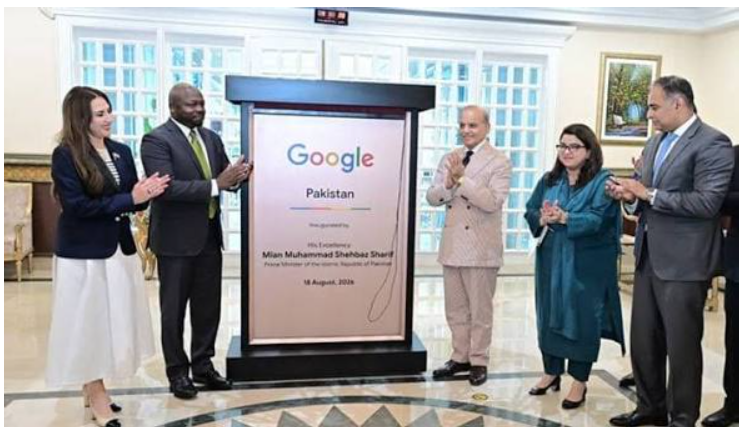
The opening took place in Islamabad during a meeting between Prime Minister Shehbaz Sharif and a nine-member Google delegation led by Wilson White, Google’s Vice President for Government Affairs and Public Policy. The development gives Google a formal local corporate presence at a time when Pakistan is actively trying to attract global technology companies and strengthen its digital economy.
The government has presented the move as a sign of growing confidence in Pakistan’s technology potential.
Federal Minister for IT and Telecommunications Shaza Fatima Khawaja also described Google’s presence as a major milestone for Pakistan’s digital ecosystem, particularly because of the opportunities it could create for young people and digital businesses.
At the same time, it is important to keep expectations realistic. The opening of a local office does not automatically mean Pakistan is becoming Google’s next major global engineering or research hub. For now, its significance lies in Google establishing a more direct local corporate presence and strengthening its engagement with Pakistan’s businesses, government and wider technology ecosystem.
Google has already been active in Pakistan for years through education, digital skills, technology partnerships and other initiatives. Its decision to establish a local office therefore appears less like a sudden arrival and more like the next step in a relationship that has gradually expanded.
In November 2025, Pakistan’s Ministry of IT and Telecommunications announced that Google and its local partners had launched the country’s first Chromebook assembly line at the National Radio and Telecommunication Corporation facility in Haripur. The project was intended to support affordable access to digital devices while also creating local manufacturing and technical opportunities.
The same announcement said Google had already trained more than one million Pakistanis through its digital programmes. The government also said Google was planning a stronger local presence to provide on-the-ground support to businesses and help them scale internationally. Against that background, the 2026 office opening represents a more formal commitment to engaging with Pakistan’s growing technology ecosystem.
The timing is particularly important because Pakistan’s technology sector is expanding at a time when digital services are becoming increasingly important to the national economy. According to the government, Pakistan’s annual IT exports have reached $4.6 billion, representing a 21 percent increase. IT exports and digital infrastructure have also been identified as major priorities for future economic growth.
Pakistan has another major advantage: its population is young. The Ministry of IT has highlighted that around 64 percent of the country’s population is under the age of 30. That represents a huge potential workforce and consumer market for digital services, online education, artificial intelligence, e-commerce, cloud computing and other technology-driven industries.
For companies such as Google, Pakistan is therefore not simply a market of consumers. It is also a potential source of developers, entrepreneurs, creators, freelancers and technology professionals who can participate in the global digital economy.
One of the most important potential effects of Google’s local presence could be on businesses. Pakistan has thousands of small and medium-sized businesses that are increasingly moving online, and for many of them, digital tools are no longer optional. They rely on search engines to reach customers, advertising platforms to promote products, cloud services to manage operations and digital analytics to understand consumer behaviour.
A stronger local Google presence could make it easier for Pakistani businesses to engage directly with the company and access its products, partnerships and support. The Ministry of IT has previously said that Google’s local presence would help businesses scale their operations and reach global markets.
If that develops at scale, the impact could extend far beyond Pakistan’s technology industry. A small business in Lahore, Karachi or Islamabad that learns how to use digital tools more effectively can potentially reach customers outside Pakistan without needing a physical presence in those markets.
Pakistan’s startup ecosystem has spent years trying to attract international investment and build companies capable of competing beyond the domestic market. Google’s presence could add another layer to that ecosystem by creating stronger connections with global technology, cloud computing and developer networks.
Startups could potentially benefit from access to digital tools, AI capabilities, developer programmes, cloud services and international networks. These resources can be particularly valuable for early-stage companies that are trying to build products while keeping their operating costs manageable.
However, there is an important distinction. Google opening an office does not automatically mean that it will directly invest in Pakistani startups. The real impact will depend on the partnerships, programmes, commercial opportunities and local initiatives that develop around the new presence. That is why the next few years may ultimately matter more than the opening ceremony itself.
If there is one area where Google’s presence could become particularly important, it is artificial intelligence. Pakistan is already trying to expand its AI capabilities, and the government launched its AI-based Prime Minister’s Office System in July 2026 with the aim of digitizing the monitoring and implementation of government directives.
At the same time, Pakistan is developing broader initiatives around AI skills and digital transformation. Google’s expertise in AI, cloud computing and digital tools could potentially support these ambitions through training, partnerships and wider technology adoption.
For Pakistani students and professionals, this could be especially significant. The global technology industry is increasingly rewarding people who can combine traditional professional skills with AI capabilities. Pakistan has a large pool of young and talented people; the bigger challenge is ensuring that they have access to the tools, training and international opportunities needed to compete.
This is probably one of the first questions Pakistani technology professionals will ask: will Google’s office create jobs?
Potentially, yes, but expectations should remain realistic. The opening of a local corporate office does not mean thousands of software-engineering positions will suddenly become available. The nature and scale of local hiring will depend on how Google develops its business operations in Pakistan.
The wider employment effect could be more significant. Greater international technology activity can create demand for local partners, consultants, cloud professionals, digital marketers, cybersecurity specialists, sales professionals and other technology-related roles. It can also encourage other global technology companies to consider Pakistan more seriously.
In that sense, the wider ecosystem effect could eventually matter more than the number of people employed directly by Google.
Pakistan has set ambitious goals for its technology sector, with the government pushing to increase IT exports and attract international investment into the digital economy. Recent government statements have also emphasized the goal of making Pakistan a regional technology and IT hub.
Google’s presence could support that ambition by strengthening Pakistan’s connection with the global technology industry. Greater access to international technology companies can help businesses understand global standards, develop new skills and potentially reach customers beyond the domestic market.
But an office alone cannot transform IT exports. Pakistan still needs reliable digital infrastructure, better connectivity, skilled workers, predictable regulations, strong cybersecurity and an environment in which technology businesses can grow. Google can contribute to that ecosystem, but it cannot build the entire ecosystem by itself.
This may ultimately be one of the most important questions surrounding Google’s arrival. When a major global technology company establishes a formal presence in a country, other companies naturally pay attention. Google is not the only international technology company working with Pakistan, but its scale and global reputation make its decision particularly notable.
The government has already been pursuing partnerships with international technology companies around digital skills, AI and business development. If Pakistan can demonstrate that these partnerships are commercially viable and that international companies can operate successfully within the country, it could become more attractive to other global technology firms.
That could bring investment, expertise and competition into the market. For local businesses, greater competition can be challenging, but it can also encourage innovation, better services and stronger professional standards.
For Pakistani students, the most immediate impact may not be a Google job. It could be access to skills and opportunities that make them more competitive in the global digital economy.
Google has previously worked with Pakistani partners on programmes designed to introduce young people to coding, computer science and digital skills. Its expanding presence could create more opportunities for training, certifications, digital learning and exposure to global technology ecosystems.
For a student studying computer science, business, design, marketing or even communications, these skills can increasingly translate into international opportunities without requiring relocation. That is one of the biggest changes taking place in Pakistan’s digital economy: talent can increasingly work for global markets while remaining in Pakistan.
Pakistan has a large and growing freelance workforce, and access to international clients and reliable digital tools is critical for freelancers. Google’s local presence could potentially make it easier for Pakistani freelancers and small digital businesses to engage with its products and services through a more formal local ecosystem.
However, it would be too early to claim that the office will automatically increase freelance earnings or create a wave of new international clients. Those outcomes will depend on how Google’s services, programmes and partnerships evolve and how effectively Pakistani freelancers take advantage of them.
The opportunity is there, but the results will ultimately depend on execution, skills and the ability of Pakistani professionals to compete in an increasingly crowded global market.
One of the most interesting parts of Google’s growing engagement with Pakistan has been its focus on students and AI-powered learning. In October 2025, Google announced a one-year free subscription to its Google AI Pro plan for eligible university students aged 18 and above in Pakistan. The offer provided access to advanced Gemini capabilities along with tools such as Deep Research, Gemini in Google apps, NotebookLM, higher AI usage limits and 2 TB of cloud storage.
For Pakistani students, the significance of such programmes goes beyond simply getting access to a premium AI tool. Students can use AI to understand difficult concepts, organise research, analyse study material, prepare presentations, improve writing and explore new areas of knowledge. Google has also been developing Gemini specifically for learning, with features designed to provide step-by-step explanations, create quizzes and study guides, and give students personalised feedback.
Although that particular one-year student offer is no longer available, it reflects the direction in which Google is taking its relationship with Pakistan’s young population. The bigger opportunity is the growing access to AI tools that can help students develop skills that are increasingly valuable in the global workforce. For a country where a large share of the population is under 30, making advanced digital and AI capabilities accessible to young people could become one of the most meaningful long-term effects of Google’s expanding presence in Pakistan.
Google’s first local office in Pakistan is more than the arrival of another multinational company. It comes at a time when Pakistan is trying to transform its economy through technology, increase IT exports and prepare its young population for an increasingly digital world.
The company already has a history of working with Pakistan through education, digital skills, hardware assembly and technology partnerships. The new office gives that relationship a stronger local foundation and creates the possibility of deeper engagement between Google and Pakistan’s growing technology ecosystem.
But the real opportunity lies ahead. If Pakistan can combine Google’s technology and global reach with its own young workforce, entrepreneurs and growing digital economy, the relationship could create opportunities well beyond the office itself.
Google is now physically present in Pakistan. The bigger question is what Pakistan can build around that presence.