Pakistani Hero is a private digital media platform dedicated to showcasing inspiring Pakistani professionals creators and achievers who are making a meaningful impact in their fields We document real journeys highlight genuine contributions and build long term digital recognition for individuals shaping Pakistan’s present and future nationally and globally. Pakistani Hero is a private digital media platform dedicated to showcasing inspiring Pakistani professionals creators and achievers who are making a meaningful impact in their fields We document real journeys highlight genuine contributions and build long term digital recognition for individuals shaping Pakistan’s present and future nationally and globally

Pakistan's Shark Rescue Plan 2026:

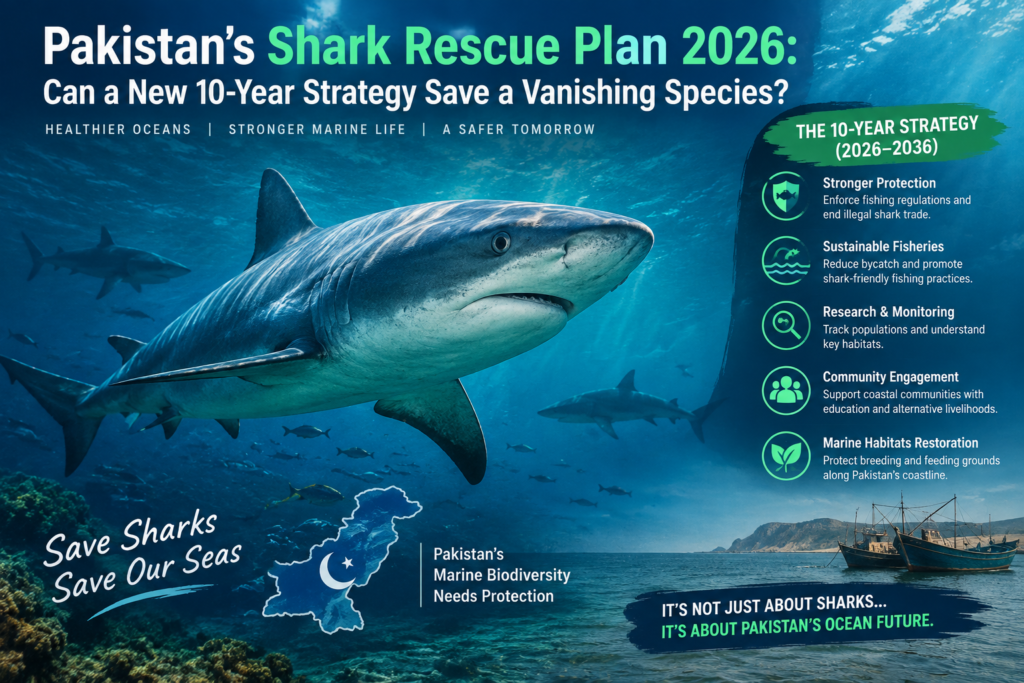
Pakistan's Shark Rescue Plan 2026: Can a New 10-Year Strategy Save a Vanishing Species?

Pakistan has taken an initial step toward reversing one of the least heralded crises in coastal waters: the near collapse of its shark populations

Overview

Pakistan has taken an initial step toward reversing one of the least heralded crises in coastal waters: the near collapse of its shark populations. On 8 September 2026, Federal Minister for Maritime Affairs Muhammad Junaid Anwar Chaudhry announced Pakistan’s first-ever 10-year National Plan of Action for the Conservation and Management of Sharks, NPOA-Sharks Pakistan 2025–2035. The plan calls for efforts to replenish the numbers of these apex predators while also reducing illegal fining and by-catch and protecting marine ecosystems so that the abundance and biodiversity of Pakistan’s sharks and rays can recover in its coastal and offshore waters through 2035.

The announcement comes at a crucial moment, for shark and ray landings dropped by nearly 90 percent between a peak of almost 55,000 metric tons in 1999 and just over 6,000 tons in 2019, according to a 2025 study in the Pakistan Journal of Zoology. Industry estimates put the number of sharks caught annually in Pakistan between 350,000 in 1999 and about 5,000 in recent years, according to the same report. For a country which is home to 144 known species of shark, many of which are critically endangered, its coastal waters constitute one of the world’s most diverse and vulnerable shark habitats.

What Is the NPOA-Sharks Pakistan 2025-2035?

National Plan of Action for Conservation and Management of Sharks is Pakistan’s first ever national strategy to conserve and manage sharks. It will be implemented by the country’s Marine Fisheries Department in three phases during the next 10 years, under the supervision of a National Advisory Committee, which will be formed by the federal government, as well as provincial governments and stakeholders.

Why Pakistan now moves to save its vanishing sharks

The plan includes all the species of sharks, rays, skates, and chimaeras found in Pakistani waters, with a specific focus on those species, which are either targeted by fisheries or are subject to high rates of by-catch. The government hopes that the plan will make Pakistan a regional leader in sustainable shark fisheries by 2035. This plan aligns Pakistan with the Food and Agriculture Organization’s International Plan of Action for the Conservation and Management of Sharks (IPOA-Sharks), which promotes the development of similar national initiatives by member states.

How Much Will It Cost, and Who Is Paying?

The government expects the first five years of implementation to cost anything between $3.8 million and $5 million. This is to be met partly by state funds, international donors, and the private sector, so as not to rely solely on national finances.

The reason why conservation programs of such a large scale are mostly funded through a combination of state and donor funds, rather than just government money, speaks volumes about Pakistan’s financial situation. It is not in a position to fund such a program on its own, despite the country’s economic importance. And, the fact that international donors are interested shows that the shark phenomenon is of global concern, rather than just a regional one.

Why Pakistan's Sharks Are Disappearing

Sharks play a vital role in the oceanic food pyramid, and their decline may have a cascading effect on entire ecosystems. Being at the top of the food chain, sharks are crucial to the regulation of the number of species below them – including coral reefs, which in turn are essential for coastal fisheries, supporting food security and economies of coastal populations. The loss of sharks as top predators can lead to the disruption of entire food webs and the depletion of commercially important fish species.

The main reasons for the decrease in numbers in Pakistan were the result of both intentional and accidental catches, while the destruction of their habitats is also a serious threat to their survival. There is a demand for shark fin products, such as shark-fin soup, in Asian countries, which makes nations like Pakistan prone to illegal hunting and trade. The minister pointed out that even though several species, including requiem, hammerhead, thresher, mackerel, whale, and basking sharks, were banned from catch, illegal fishing still poses a threat to biodiversity and the country’s reputation as an environmentally conscious nation

The Basking Shark: A Case Study in Vulnerability

The basking shark has become a symbol that represents the plan. This is a highly migratory species in the Arabian Sea which is categorized as endangered in the International Union for Conservation of Nature’s Red List. Its slow growth and low reproductive rates make it particularly vulnerable to anthropogenic activities such as entanglement in fishing gear and ship collisions, which a species with low reproductive potential cannot compensate for.

Authorities warn that continued unsustainable fishing practices with such species at risk threatens not only the local marine ecosystem, but also Pakistan’s seafood trade, as global consumers and conservation groups grow increasingly wary of the origin of their seafood imports.

The Bigger Regional Picture

The crisis of sharks in Pakistan is not an isolated event. A landmark assessment of sharks, rays and chimaeras by the International Union for Conservation of Nature found nearly half of all species surveyed in the wider Arabian Sea region (78 out of 153) are at higher risk of extinction, compared to most other regions assessed. Many of the shark species in this region are endemic to the area, meaning they cannot be found anywhere else, so their loss would be irreversible.

More than a third of all shark species around the world are considered threatened with extinction, due to overfishing, finning and habitat loss. The situation in Pakistan is similar to that of the global scenario but with additional constraints, and despite bans, shark fins and meat are still being exported illegally from the country.

What the Plan Actually Does on the Ground

Beyond the funding and framework, the NPOA sets out concrete operational commitments:

  • Stronger enforcement of existing shark-protection laws
  • Deployment of vessel monitoring systems across key fishing zones
  • Expanded landing-site monitoring at ports and harbours
  • Annual stock assessments to track population recovery
  • Annual reviews against performance indicators, with formal reviews every three years

The plan also leans on international cooperation, including through bodies such as the Indian Ocean Tuna Commission, to align Pakistan’s shark-management practices with regional and global standards. Provincial governments in Sindh and Balochistan home to Pakistan’s main fishing communities and harbours have been closely involved in shaping the plan, reflecting the reality that federal policy alone cannot fix a problem rooted in local fishing practices and livelihoods.

Protecting Sharks While Protecting Livelihoods

One of the plans more delicate balancing acts is ensuring that conservation does not come directly at the expense of coastal fishing communities who rely on the sea for their income. The strategy specifically provides support for alternative and sustainable livelihood opportunities for fishers, and training and awareness programmes to help them identify protected species and follow conservation regulations.

This matters because previous conservation efforts in fisheries-dependent economies have often struggled when restrictions were imposed without providing fishers with an alternative option. Karachi’s fishing harbours, in particular historically Pakistan’s centre of shark fishing for over a century will be a key test of whether enforcement and livelihood support can be pursued in parallel rather than at odds with each other.

The Data Problem Pakistan Still Needs to Solve

A recurring theme among experts writing about Pakistan’s marine fisheries is the lack of reliable data. Out of the 144 known species of sharks in Pakistan, only 35 have been studied in any detail, and the status of some indigenous species is unknown. Enhancing data gathering and scientific research on sharks was one of the minister’s explicitly stated goals in announcing the plan.

Without these data, there is no way to evaluate whether the plan is achieving its goals, or just creating an illusion of activity. Emphasis on improving annual stock assessments and monitoring systems implies that policymakers are aware of the issue, but building scientific and law-enforcement capacity to address it will likely take years.

Can the Plan Actually Succeed?

A: The truth is that it is too early to say. Pakistan has a long history of announcing conservation initiatives, while federal authorities and conservation groups such as WWF-Pakistan have been calling for a national action plan for shark conservation for almost ten years with little to show. This plan, however, stands out from the rest as it has a funding estimate, timeline, and institutional organization, which differentiates it from previous announcements.

Still, the plan faces several significant challenges, such as the small size of the proposed fund, the informal small-boat fishing industry, the lax enforcement of existing bans, and a ten-year timeframe, which spans over several government terms. In my opinion, the survival of the plan within Pakistan’s political system and its budget allocation over the span of ten years will define its success no less than the plan’s details.

What Success Would Look Like by 2035

If the plan is successful, Pakistan will witness the recovery of its shark and ray landings, documented decreases in the number of animals caught as bycatch and killed, operating vessel monitoring and landing site surveillance systems in major fisheries, and improved coastal communities that rely on catching banned species, as well as meeting its international obligations regarding the preservation and protection of the region’s species and expanding its seafood trade prows while ensuring sustainability.

Failure would most likely present the image of an ineffective plan that failed to enforce the necessary precautions and protections for the region’s animals, resulting in illegal finning and bycatch continuing to flourish without any effective government intervention while funds are poorly allocated at best and another decade goes by with inadequate data to determine if any changes have taken place.

Conclusion

Pakistan’s NPOA Sharks 2025-2035 is the most comprehensive plan to date that addresses the country’s persistent problem of marine biodiversity loss. The number of shark and ray landings has dropped by almost 90 percent since peaking in 1999, and the Arabian Sea has become one of the world’s most at-risk regions for shark biodiversity. Pakistan’s plan to conserve its sharks is important because it has clear parameters that eluded previous initiatives, including an estimated budget, a timeline, interagency oversight, and performance measures. What the plan lacks is certainty. Given a decade to make progress, Pakistan’s sharks will be safe if the political and bureaucratic will exist to see the program through to fruition.

FAQS

It is the National Plan of Action for the Conservation and Management of Sharks (NPOA-Sharks Pakistan 2025-2035), the country's first 10-year national strategy to restore shark populations and curb illegal fishing practices.

Federal Minister for Maritime Affairs Muhammad Junaid Anwar Chaudhry announced the plan on September 8, 2026.

The first five years are estimated to require $3.8 million to $5 million, funded through government allocations, international donors, and private-sector contributions.

It covers all chondrichthyan species in Pakistani waters — sharks, rays, skates, and chimaeras — with particular focus on banned species such as requiem, hammerhead, thresher, mackerel, whale, and basking sharks.

Overfishing, accidental bycatch in fishing gear, habitat degradation, and continued demand for shark fins and meat despite existing bans are the main drivers.

It is a migratory Arabian Sea species classified as endangered by the IUCN, highly vulnerable due to its slow growth and low reproduction rate, and one of the species the plan specifically aims to protect.

Through annual reviews against indicators like landing-site monitoring, stock assessments, and vessel monitoring systems, with more comprehensive formal reviews every three years.

The plan includes provisions for alternative and sustainable livelihood support, training, and awareness programmes for coastal fishing communities alongside its conservation measures.

About This Story

BE PART OF OUR MISSION

Share Real Stories of Pakistan

Do you know someone who is making Pakistan proud? Nominate them and we will tell their story.

Latest News

Book a meeting