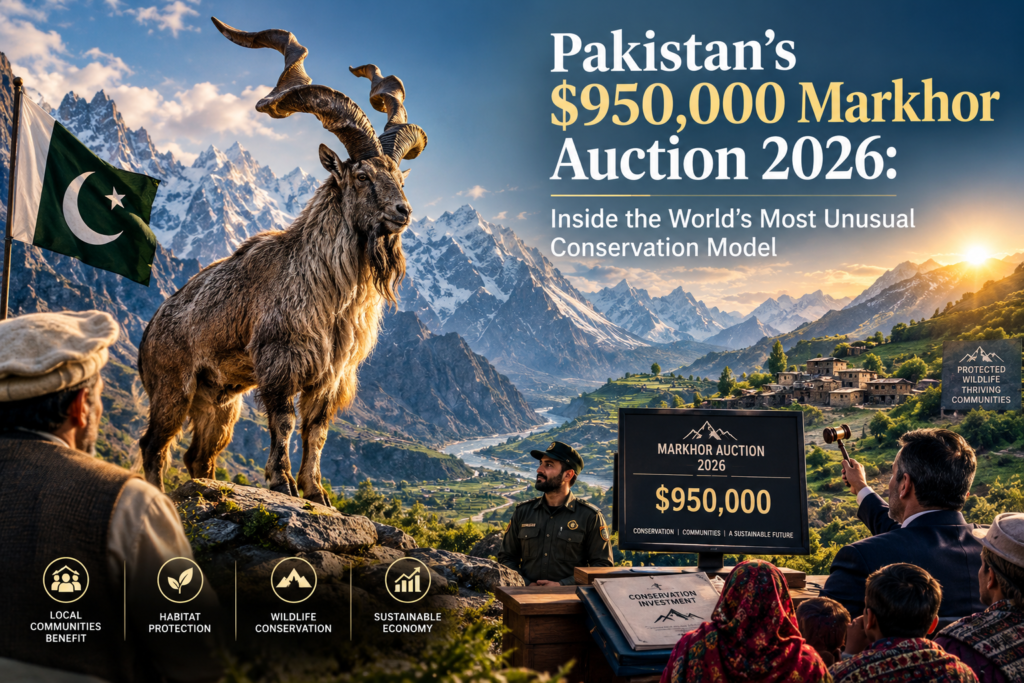
In September 2026, Pakistan’s Gilgit-Baltistan region once again drew the attention of the international hunting and conservation world. At an open auction held in Gilgit, three permits to hunt the elusive Astore markhor sold for a combined total of roughly $950,000, with the single highest permit fetching $356,000 on its own. Alongside the markhor permits, the same auction sold licenses for over a hundred blue sheep and Himalayan ibex, together forming one of the most closely watched wildlife auctions anywhere in the world.
For many outside Pakistan, the idea of paying hundreds of thousands of dollars to hunt an endangered goat sounds contradictory to conservation itself. Yet this auction is part of a decades-old programme that conservationists credit with helping pull the markhor back from the brink of extinction. Understanding how the numbers work, and why the model has endured since 1990, explains why Pakistan’s unusual approach to protecting its national animal keeps making global headlines.
The Gilgit-Baltistan Forest, Parks and Wildlife Department auctioned 117 trophy hunting permits for the 2026-27 season at the Forest, Parks and Wildlife Complex in Gilgit. Of these, the three Astore markhor permits were the headline items. The top permit sold for $356,000, the second for $301,000 and the third for $294,000, bringing the combined total for the three markhor tags to roughly $951,000. A fourth Astore markhor permit had already been carried forward from the previous hunting season.

The 2026-27 auction did not set a new single-permit world record; that distinction still belongs to the $370,000 bid placed during the 2025-26 season for a permit in the Nanga Parbat Conservancy. Even so, this year’s combined total across three markhor permits underscores how consistently high demand has become. Wildlife officials say they expect the full 2026-27 hunting season, running from October 15 to April 10, 2027, to generate around Rs650 million for the region.
The auction also included permits for 14 blue sheep and 100 Himalayan ibex. The highest exportable blue sheep permit sold for $31,200, while the lowest bid for the species came in at $25,100. Base prices for the season had been raised in advance, with markhor permits starting at $200,000, blue sheep at $25,000 and ibex at $11,000, reflecting steadily rising demand from international hunters over recent years.
The Astore markhor is one of several markhor subspecies and is officially recognised as Pakistan’s national animal. On paper, auctioning permits to shoot a limited number of them each year seems at odds with protecting the species. In practice, the programme is built around a specific principle: hunters are permitted to take only old, post-breeding males that have already passed on their genes and would otherwise die naturally within a season or two. The high price paid for a single animal is meant to fund protection for the entire population.
Roughly 80 percent of the revenue collected through these permits is channelled directly to local communities living in the markhor’s habitat, while the remaining share goes to the government. Communities have used these funds to support schools, health clinics, scholarships and small business loans. The underlying idea is straightforward: when local residents earn more from keeping markhor populations healthy than from poaching them, they become active protectors of the species rather than threats to it.
The community-based trophy hunting programme in Gilgit-Baltistan was first introduced in the Nagar Valley in 1990. Over more than three decades, it has become one of Pakistan’s most internationally recognised conservation initiatives, frequently cited by wildlife economists as a model for how regulated, high-value hunting can align financial incentives with species recovery.
Conservationists point to a genuine recovery in markhor numbers in areas covered by the programme since it began. The species, once increasingly rare due to unregulated poaching, has seen population growth in community-managed conservancies where trophy hunting revenue funds anti-poaching patrols and habitat protection. This turnaround is central to why Pakistan continues to defend the model publicly, even as it draws criticism from some international animal welfare groups.
Not everyone is convinced. Critics argue that placing a six-figure price tag on the life of an endangered animal sends the wrong message internationally, regardless of the conservation outcomes. Supporters counter that without this revenue stream, remote mountain communities would have far weaker incentives to protect markhor habitat from illegal hunting, grazing pressure and encroachment. The debate has run alongside the programme for years, even as permit prices have climbed steadily.
Buyers typically include international trophy hunters working through licensed outfitters, some of whom pay non-refundable deposits and send agents to bid on their behalf at the Gilgit auction. The Astore markhor’s dramatic spiralling horns and the difficulty of the hunt itself, conducted at altitudes above 10,000 feet in the Karakoram and Himalayan ranges, add to its appeal among big-game hunters worldwide.
Permit prices have risen sharply over the past decade, from highs in the low hundred-thousands earlier in the 2020s to the $270,000-$370,000 range in recent seasons. The government has responded by raising base prices for each new season, a sign of how consistently demand from international hunters has outpaced supply, given that only a handful of Astore markhor permits are issued each year.
Pakistan’s markhor auction has become an unusual but genuine point of international attention, one where the country is recognised not for a crisis but for a working, revenue-generating conservation programme. It sits alongside other stories of Pakistan’s growing global visibility, from its expanding startup ecosystem to its cultural exports, as an example of the country shaping how it is perceived abroad.
Wildlife economists and conservation groups in other countries with endangered mountain species have studied Gilgit-Baltistan’s approach as a potential template. Whether or not the model can be replicated elsewhere, Pakistan’s markhor programme remains one of the clearest real-world examples of a controversial idea: that in the right conditions, high-value regulated hunting can fund the survival of the very species being hunted.
The 2026 Gilgit-Baltistan auction, with three Astore markhor permits selling for a combined $950,000-plus and more than a hundred other permits going under the hammer, is the latest chapter in a conservation experiment that has run for more than 30 years. It remains ethically contested, but the numbers behind it, rising prices, growing community revenue and a national animal that has moved back from the edge of extinction, explain why Pakistan continues to stand by the programme. As the 2026-27 hunting season gets underway in October, the markhor auction is likely to keep drawing both hunters and headlines in equal measure.
Three Astore markhor permits sold for a combined total of roughly $950,000 ($356,000, $301,000 and $294,000) at the Gilgit-Baltistan trophy hunting auction for the 2026-27 season.
The current record single-permit price is $370,000, set during the 2025-26 season for a permit in the Nanga Parbat Conservancy.
The programme only permits hunting of old, post-breeding male markhors, and the high permit fees fund local conservation and community development, an approach credited with helping markhor populations recover.
Around 80 percent of permit revenue goes to local communities in the markhor's habitat for schools, clinics and development projects, while the remaining 20 percent goes to the government.
The community-based programme was launched in Gilgit-Baltistan's Nagar Valley in 1990.
The same auction included permits for 14 blue sheep and 100 Himalayan ibex.
The season runs from October 15, 2026 to April 10, 2027.
Supporters point to measurable conservation gains and community benefits, while critics argue that hunting endangered animals for a fee is ethically problematic regardless of the outcomes.