
Join Us
Follow us on social media for daily updates and inspiring stories

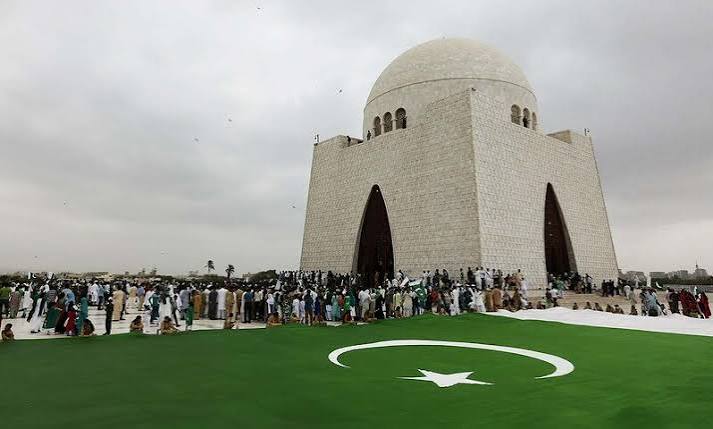
Every August, Pakistan’s Independence Day brings familiar images: flags on rooftops, national songs in the streets and stories about the struggle that led to the creation of the country in 1947.
But in recent years, another phrase has become increasingly prominent in Pakistan’s national commemorations: Marka-e-Haq.
The term gained prominence following the May 2025 conflict between Pakistan and India and has since become part of official commemorations. In 2026, the government formally marked the first anniversary of Marka-e-Haq and announced that May 10 would be observed every year as Marka-e-Haq Day.
The story has now moved beyond speeches and ceremonies.
A dedicated Marka-e-Haq Monument has been developed in Islamabad, while another monument was constructed at Buggy Park near Kutchery Chowk in Rawalpindi. These projects turn a recent national event into something physical and permanent.
So what does Marka-e-Haq actually mean for Pakistan today?
And why is it becoming part of the country’s broader national narrative?
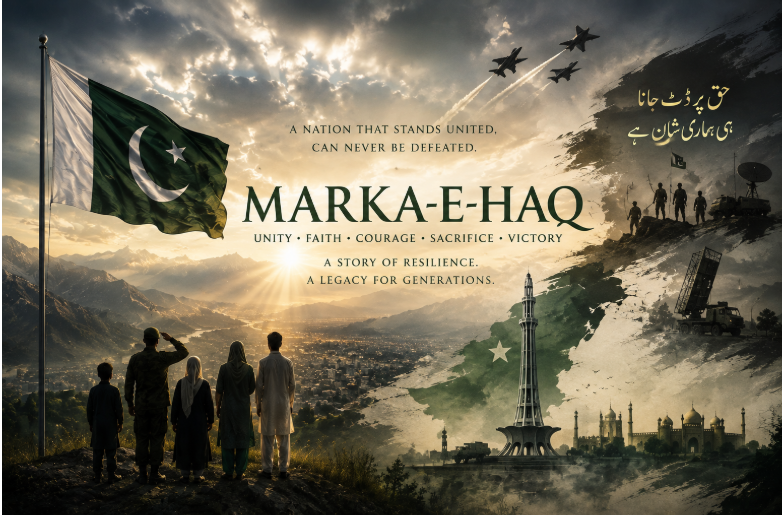
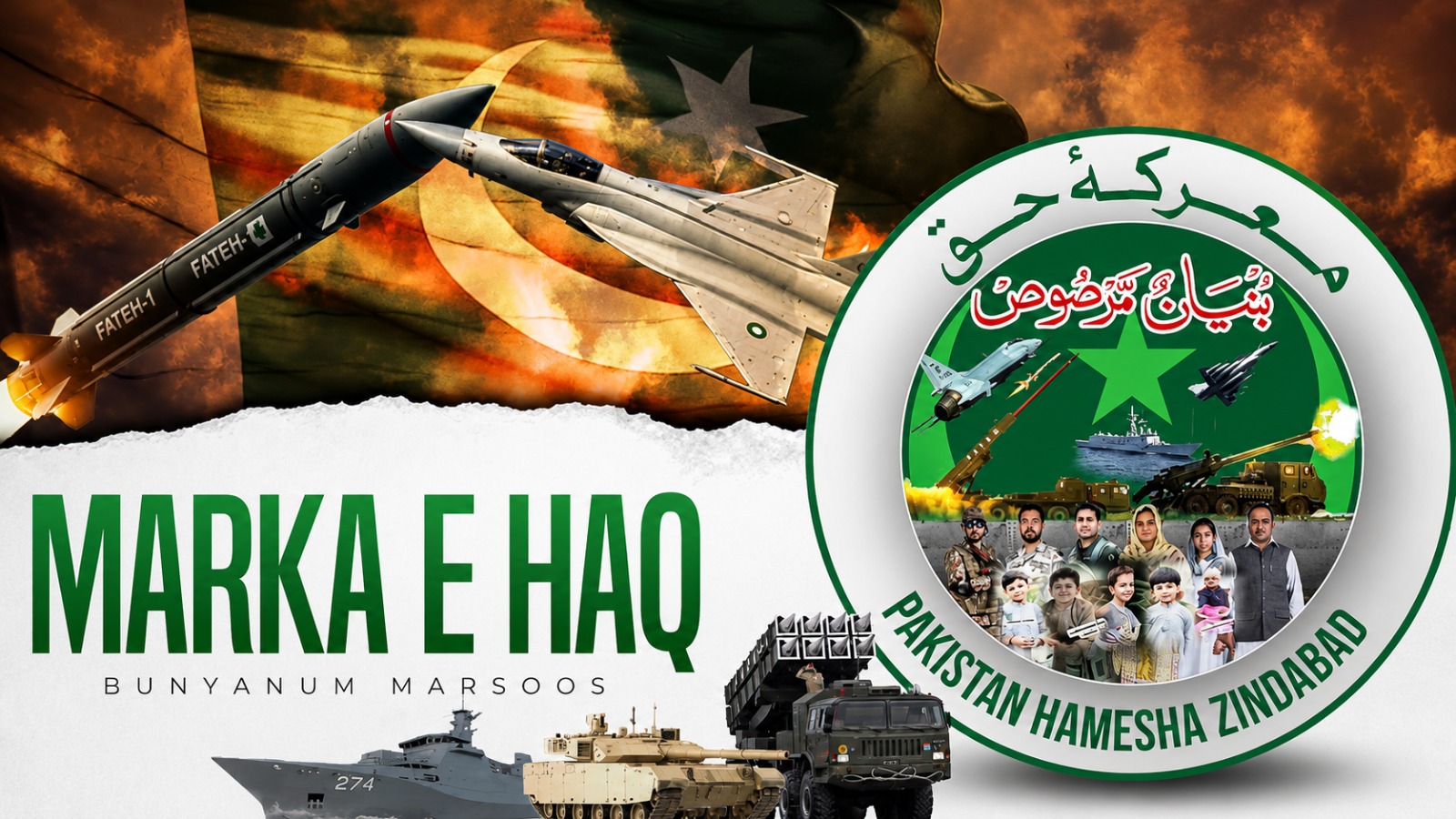
Marka-e-Haq, commonly translated as the “Battle of Truth,” is the name used by the Pakistani government for the military confrontation with India in May 2025 and Pakistan’s subsequent response under Operation Bunyan-un-Marsoos.
The Pakistani government describes the episode as a defining moment in which the country responded to what it characterized as Indian aggression and demonstrated national unity and military capability.
At the first anniversary ceremony in May 2026, Prime Minister Shehbaz Sharif described Marka-e-Haq as a major national victory and announced that May 10 would be observed annually as Marka-e-Haq Day.
The government’s messaging around the commemoration has consistently focused on three themes: unity, resilience and national defence.
That framing has also shaped how Marka-e-Haq is now represented through monuments, exhibitions, commemorations and public events.
One of the most interesting developments is how quickly Marka-e-Haq has moved from being a recent military event to becoming part of Pakistan’s public commemorative calendar.
In August 2025, Pakistan’s Independence Day celebrations were officially linked with the commemoration of Marka-e-Haq. Events were held across the country, including exhibitions, cultural programmes and ceremonies paying tribute to those who died during the conflict.
At Lok Virsa in Islamabad, for example, Independence Day and Marka-e-Haq were commemorated together on August 14, 2025, with a photo exhibition and cultural activities.
The connection is significant.
Pakistan’s Independence Day traditionally looks back to 1947 and the creation of the country.
Marka-e-Haq introduces a much more recent chapter into that national story.
It connects the idea of defending Pakistan’s independence with a contemporary event that remains fresh in public memory.
A monument does something that a news report or speech cannot.
It gives a historical event a physical place.
The Marka-e-Haq Monument in Islamabad was designed and constructed by the Frontier Works Organization. According to FWO, the structure is intended to symbolize unity, sacrifice and collective resilience. Its design incorporates five arches representing the five pillars of faith, while the complex includes a historical display hall documenting what FWO describes as the defence, diplomatic, information and public-resilience dimensions of Marka-e-Haq.
Construction of the Islamabad monument began in August 2025 in the H-8 area.
That makes the monument more than an architectural project.
It is an attempt to preserve a particular interpretation of a recent event for future generations.
National monuments have always played a role in shaping how countries remember their past.
Pakistan already has landmarks such as the Pakistan Monument in Islamabad, which represents the country’s provinces and territories and has become one of the capital’s most recognizable national symbols.
The Marka-e-Haq Monument belongs to a different generation of national memory.
Its subject is not the creation of Pakistan in 1947 or one of the country’s earlier wars. It commemorates an event that happened only recently.
That raises an interesting question:
How does a country decide which recent events deserve to become permanent parts of its national memory?
In Pakistan’s case, the answer increasingly appears to include events associated with national defence, sacrifice and collective resilience.
Unity has become one of the most repeated themes in official Marka-e-Haq commemorations.
At the 2026 anniversary ceremony, President Asif Ali Zardari described the episode as extending beyond military achievements and reflecting the unity and harmony of the Pakistani nation.
Similarly, official messages surrounding the anniversary repeatedly highlighted the idea that civilians and the armed forces stood together during the crisis.
This is important because national resilience is rarely about military capability alone.
A country’s response to a crisis can also involve civilians, emergency services, media, diplomacy, economic institutions and communities.
That broader interpretation is one reason Marka-e-Haq has increasingly been presented as a story about the nation as a whole, rather than solely a military episode.
Perhaps the most important question is what Marka-e-Haq means to people who were not directly involved in the events of 2025.
For younger Pakistanis, national history is increasingly experienced through social media, digital content, documentaries, photographs and public events.
That makes the way historical events are presented particularly important.
The National Archives of Pakistan, for example, organized an Independence Day and Marka-e-Haq exhibition in 2025 featuring rare photographs, documents and archival material connected to Pakistan’s history. Students were also invited to participate in quiz and speech competitions.
This kind of engagement can make history feel less distant.
Instead of simply reading dates in a textbook, young people encounter history through photographs, exhibitions, monuments and public spaces.
The evolution of Marka-e-Haq over the past year is particularly notable.
May 2025: The conflict took place and Pakistan launched Operation Bunyan-un-Marsoos in response to the confrontation.
August 2025: Marka-e-Haq became closely associated with Pakistan’s Independence Day commemorations, with events held across the country.
August 2025: Construction of the Marka-e-Haq Monument in Islamabad began.
May 2026: Pakistan observed the first anniversary of Marka-e-Haq. Prime Minister Shehbaz Sharif announced that May 10 would be commemorated annually as Marka-e-Haq Day.
August 2026: The monument project moved toward completion, adding a permanent physical landmark to the commemoration.
In just over a year, Marka-e-Haq has therefore moved from a recent conflict to an established part of Pakistan’s commemorative landscape.
This is where the story becomes particularly interesting.
Pakistan’s Independence Day is fundamentally about freedom.
Marka-e-Haq, as presented in official commemorations, is about defending that freedom.
The two narratives are therefore being placed alongside one another.
That does not mean they are the same historical event. They are separated by almost eight decades.
But together, they create a broader narrative:
1947 represents the creation of Pakistan, while contemporary commemorations of Marka-e-Haq emphasize the responsibility of protecting its sovereignty.
This is one reason the theme has become particularly visible around August 14.
National identity is never completely static.
Every generation adds its own experiences to the story of a country.
For Pakistan, the founding generation is remembered through the Pakistan Movement, the leadership of Muhammad Ali Jinnah and the creation of the country in 1947.
Later generations grew up with memories of the 1965 and 1971 wars, the 1998 nuclear tests, the war against terrorism and other major national events.
Marka-e-Haq now represents another contemporary chapter.
Whether it eventually becomes as deeply embedded in public memory as earlier historical events remains to be seen.
But the monuments and annual commemorations suggest that it is already being given a permanent place in the national narrative.
There is another way to look at the Marka-e-Haq story.
A national commemoration does not have to be understood only through the lens of military success.
The official narrative itself increasingly emphasizes ideas such as resilience, unity, sacrifice, diplomacy and national confidence. FWO’s description of the Islamabad monument, for example, explicitly refers to defence, diplomacy, information strategy and public resilience.
That broader interpretation gives the story relevance beyond the battlefield.
For a young Pakistani, resilience could mean continuing education during difficult circumstances.
For an entrepreneur, it could mean building despite economic uncertainty.
For a community, it could mean standing together during a national crisis.
In that sense, the symbolism of Marka-e-Haq can be understood more broadly than the event itself.
Perhaps there is no single answer.
For the government and military leadership, it represents a significant national victory and a demonstration of Pakistan’s defence capabilities.
For families of those killed during the conflict, it is also a commemoration of sacrifice.
For many citizens, it has become associated with national unity and pride.
And for younger generations, monuments and exhibitions may eventually become the physical reminders through which they learn about the events of 2025.
That is the power of national memory.
It takes something that happened at a particular moment and gives it meaning that can continue across generations.
The real test of any national commemoration is what it inspires.
If Marka-e-Haq is remembered only through ceremonies, speeches and monuments, its meaning may remain largely symbolic.
But if its themes of resilience, unity and responsibility are connected to education, innovation, civic responsibility and national development, the story can take on a broader significance.
This is especially relevant for Pakistan’s younger population.
The country does not only need young people who remember its history.
It needs young people who understand it and use its lessons to shape what comes next.
Marka-e-Haq has become much more than a phrase associated with the events of May 2025.
Within a relatively short period, it has become part of Pakistan’s official commemorative calendar, with May 10 designated as Marka-e-Haq Day, while monuments and exhibitions are giving the story a permanent presence in public spaces.
Its growing association with Independence Day adds another layer to the story.
Pakistan’s independence was achieved in 1947. Marka-e-Haq, as officially commemorated today, is presented as a more recent chapter about defending sovereignty and national resilience.
The real legacy of the commemoration, however, will not be determined by monuments alone.
It will depend on how future generations understand the event, what lessons they draw from it and how those lessons shape the country’s future.
Beyond the flags, ceremonies and monuments, the bigger question is what kind of Pakistan the next generation chooses to build.