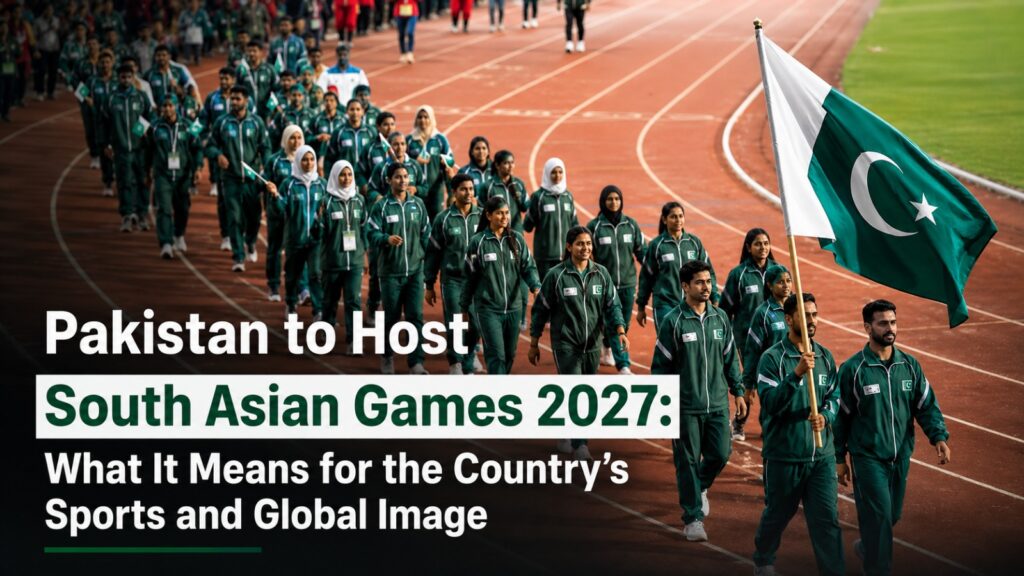
After more than two decades, the South Asian Games are returning to Pakistan. The country will host the 14th South Asian Games from April 3 to 11, 2027, with Islamabad, Lahore and Peshawar selected as the three host cities. The event will bring together around 3,200 athletes, with 28 sports and 346 medal events scheduled across 28 competition venues. The South Asia Olympic Council reviewed Pakistan’s preparations this week, while an inspection delegation visited venues in Islamabad on August 25 to assess their readiness.
For Pakistan, however, this is about more than hosting another sporting tournament. The Games represent an opportunity to showcase Pakistani athletes, upgrade sporting infrastructure, bring thousands of regional participants into the country and strengthen people-to-people connections across South Asia. They also offer Pakistan a chance to project a different image of itself, one centred on sport, youth, hospitality and regional cooperation.
The timing is significant as well. Pakistan last hosted the South Asian Games in 2004, meaning the 2027 edition will come 23 years after the country’s previous hosting.After several postponements, the return of the Games could therefore mark an important moment for Pakistan’s sporting landscape.
The decision to hold the 14th South Asian Games in Pakistan has been in development for several years. The event was originally scheduled for 2023 but was subsequently postponed multiple times. In January 2026, the South Asian Olympic Council unanimously retained Pakistan as the host and initially set the dates for March 23–31, 2027, while allowing flexibility of up to one week for operational reasons.

The schedule was subsequently adjusted, and the latest decision places the Games from April 3 to 11, 2027. The South Asia Olympic Council confirmed the new dates during its August 23–24 meetings in Islamabad, alongside the host cities and competition programme.
The final arrangement means athletes from across South Asia will compete over nine days, with representatives from Bangladesh, Bhutan, India, Maldives, Nepal, Pakistan and Sri Lanka expected to participate. India took part virtually in the latest SAOC meeting, while representatives from several other countries attended in person.
The 2027 Games will not be confined to a single city. Islamabad, Lahore and Peshawar will collectively host competitions, giving the event a broader national footprint. According to the Olympic authorities, 28 competition venues across the three cities are being prepared for the Games.
This distribution could have an important effect beyond sport itself. Hosting a major international event across multiple cities means accommodation, transportation, security, hospitality and event-management services will all be involved. It also allows more Pakistani communities to experience an international sporting event directly rather than limiting the benefits to one urban centre.
For Islamabad, Lahore and Peshawar, the Games therefore represent an opportunity to demonstrate their capacity to host athletes and visitors from across the region. They also provide a deadline for completing infrastructure upgrades that could remain useful long after the competition ends.
The 14th South Asian Games will feature 28 sports and 346 medal events, with women’s competitions included in 25 of those sports. Around 3,200 athletes are expected to compete, while the overall number of participants, including officials and other delegations, is expected to reach roughly 4,200.
The size of the programme makes the Games one of the largest multi-sport events Pakistan will host in recent years. For athletes, it also provides opportunities to compete against some of the strongest sporting talent in the region without having to travel outside South Asia.
For sports that receive limited international exposure, a regional event of this scale can be particularly valuable. It gives athletes the chance to compete under pressure, gain experience and potentially attract greater attention from national federations, sponsors and fans.
For Pakistani athletes, the biggest advantage of hosting the Games could be the opportunity to compete on home soil. Athletes often face significant challenges when travelling internationally, including accommodation, unfamiliar facilities, travel schedules and adapting to different environments. Competing at home can remove some of those barriers and allow athletes to focus more directly on performance.
The government has also framed the Games as an opportunity for young athletes to demonstrate their abilities at a regional level. Prime Minister’s Youth Programme Chairman Rana Mashhood Ahmad Khan said the event would give young players an important opportunity to showcase their talent and compete at a high level.
For younger competitors who may not yet have experience at major international events, the South Asian Games can become an important stepping stone. Success at a regional competition can help athletes gain confidence and build a stronger record before moving towards Asian Games, Commonwealth Games or Olympic-level competition.
Hosting a multi-sport event is also a major test of infrastructure. Pakistan is therefore using the period leading up to the Games to assess and upgrade venues, accommodation, transportation systems and other operational arrangements.
The South Asia Olympic Council’s recent meetings specifically reviewed venue readiness in Lahore and Peshawar, while its delegation inspected Islamabad venues on August 25. The committee is also examining accommodation, transportation, Games manuals and other operational arrangements as Pakistan enters the final phase of preparation.
The infrastructure work could become one of the most lasting outcomes of the Games. If facilities are properly renovated rather than simply given temporary improvements for the event, Pakistan could benefit from better sporting venues for years afterwards.
Pakistan’s government has already established mechanisms to oversee preparations. In August, Deputy Prime Minister and Foreign Minister Ishaq Dar directed the creation of subcommittees responsible for financing, infrastructure development, athlete preparation and logistics.
Earlier, the government had also decided to establish a dedicated SAARC Games Secretariat in Islamabad and accelerate upgrades to the Pakistan Sports Complex. The preparations involve the Ministry of Inter-Provincial Coordination, Pakistan Sports Board, provincial authorities and the Pakistan Olympic Association.
The scale of coordination required shows that hosting the Games is not simply a matter of preparing stadiums. Thousands of athletes and officials will need accommodation, transport, accreditation, medical support, security and competition services throughout the event.
Sport has long been used as a form of soft power because it allows countries to present themselves to international audiences through something less confrontational than traditional diplomacy. Pakistan’s hosting of the South Asian Games gives it an opportunity to showcase its cities, hospitality, sporting talent and organisational capacity to visitors from across the region.
The government has explicitly linked the Games to Pakistan’s international image. Ishaq Dar described the event as an opportunity to showcase Pakistan’s sporting talent and hospitality while conveying a message of peace, friendship, goodwill and harmony.
That message could be particularly relevant in South Asia, where political disagreements between countries often dominate regional headlines. Bringing athletes from neighbouring countries together for a shared sporting event creates a different kind of interaction, one based on competition but also cooperation.
India’s involvement gives the Games an additional regional significance. Indian representatives participated virtually in the recent South Asia Olympic Council meeting, while the other participating countries continued discussions on preparations.
Sports between India and Pakistan have frequently been affected by broader political tensions, making any regional sporting event involving both countries particularly significant. The South Asian Games are not designed to resolve political disputes, but sporting interactions can provide opportunities for athletes and officials from both sides to interact in a less political environment.
Whether this translates into greater sporting engagement between the two countries will depend on the wider political situation. Nevertheless, India’s participation in the regional Olympic framework remains an important part of the Games’ significance.
The South Asian Games are fundamentally designed around regional sporting cooperation. Countries that compete against one another politically or diplomatically can still share sporting institutions, rules and competitions through the regional Olympic movement.
The 2027 edition gives Pakistan an opportunity to reinforce that regional dimension. The latest SAOC meeting included representatives from Bangladesh, Bhutan, India, Maldives, Nepal, Pakistan and Sri Lanka, demonstrating the breadth of participation expected from South Asia.
In that sense, the Games can function as more than a medal competition. They can provide a temporary space where young people from different South Asian countries meet, compete and build relationships that exist outside formal diplomatic channels.
A multi-sport event involving thousands of international visitors can also create opportunities for Pakistan’s tourism and hospitality sectors. Athletes, officials, coaches, journalists and accompanying visitors will require hotels, transportation, restaurants and other services during their stay.
Islamabad, Lahore and Peshawar each offer very different cultural and historical experiences. If the Games are effectively promoted, international visitors could spend time exploring these cities alongside their sporting commitments, creating additional economic activity for local businesses.
The scale of the tourism impact will ultimately depend on how many visitors remain in Pakistan beyond the competition venues and how effectively the country presents itself as a safe and attractive destination.
The economic impact of a major sporting event is not limited to hotels and stadiums. Local transport providers, restaurants, retailers, event companies, security services, media organisations and other businesses can all become part of the wider ecosystem.
A successful Games could therefore create temporary demand across several sectors. More importantly, it could give Pakistani companies experience in managing international sporting events, which could be valuable for future competitions.
The opportunity is particularly important for small businesses in the host cities. Increased footfall and international visitors can create additional customers, while event-related contracts can provide opportunities for service providers.
The Games are also closely connected to Pakistan’s broader youth-development agenda. With thousands of young athletes participating and millions more following the competition, the event can help increase interest in sports at a time when Pakistan is looking for ways to provide young people with more opportunities outside traditional academic and professional pathways.
The Prime Minister’s Youth Programme has specifically linked the Games to youth empowerment, arguing that young athletes need more opportunities to compete nationally, regionally and internationally.
That matters because sporting success does not emerge only from elite athletes. It depends on grassroots participation, coaching, facilities, school programmes and opportunities for young people to discover their abilities in the first place.
This may be the most important question surrounding the event.
Hosting the South Asian Games can provide new facilities, international exposure and public attention, but those benefits will only last if Pakistan continues investing in sports after the closing ceremony. Stadiums cannot remain underused, and young athletes cannot be expected to produce international results without regular competitions, coaching and financial support.
The government has an opportunity to use the Games as a starting point rather than an end point. If upgraded facilities remain accessible to athletes, federations improve their training systems and more young people are brought into organised sports, the impact could extend well beyond 2027.
The immediate priority is preparation. The South Asia Olympic Council is continuing inspections and reviewing operational arrangements, while Pakistani authorities are working on infrastructure, athlete training, financing and logistics. The latest assessment confirms that the Games will take place across Islamabad, Lahore and Peshawar from April 3 to 11, 2027.
As the countdown continues, attention will increasingly shift towards Pakistan’s athletes, selection camps and venue readiness. The planned “100 Days to Go” milestone will also form part of the pre-launch activities being prepared by organisers.
After years of postponements, Pakistan now has a clear date, a confirmed host-city structure and a regional Olympic body actively monitoring preparations.
The return of the South Asian Games to Pakistan in 2027 is more than a sporting announcement. It is an opportunity for the country to showcase its athletes, modernise sporting infrastructure, support youth development and strengthen its image across South Asia.
With 28 sports, 346 medal events, around 3,200 athletes and three host cities, the scale of the event will make it a major organisational challenge. But it also gives Pakistan a rare opportunity to put sport at the centre of a broader national conversation about youth, talent and regional cooperation.
After hosting the Games in 2004, Pakistan is preparing to welcome South Asia once again, this time with Islamabad, Lahore and Peshawar sharing the stage.
The real victory will not simply be winning medals. It will be what Pakistan builds before, during and after the Games.