Pakistan and Kuwait have signed the Protocol Agreement-2026 to expand military cooperation in training, capacity building and border management. Here’s what the new agreement means.

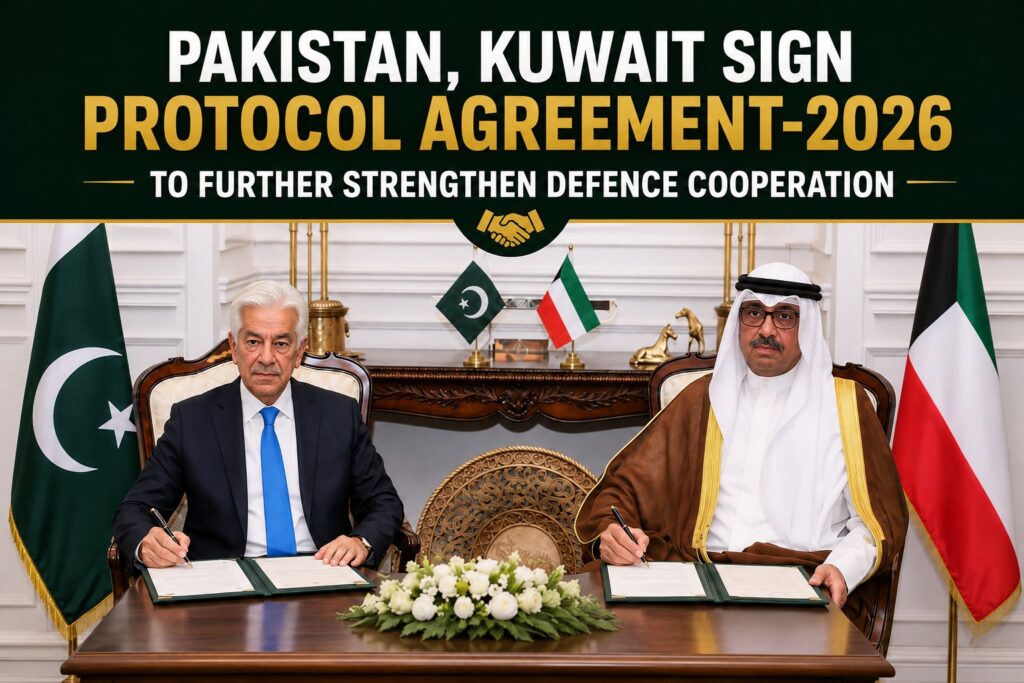
Pakistan and Kuwait have taken another step towards strengthening their longstanding defence relationship with the signing of the Protocol Agreement-2026 in Rawalpindi on August 27, 2026. The agreement expands the military cooperation framework established under the Pakistan–Kuwait Defence Cooperation Agreement of 2023 and introduces broader areas of cooperation between the armed forces of the two countries.
The development comes shortly after Kuwait completed the ratification of the 2023 Defence Cooperation Agreement in July, giving further momentum to the bilateral security relationship. For Pakistan, the latest agreement strengthens an important Gulf partnership, while for Kuwait it provides another avenue for military training, capacity building and institutional cooperation with Pakistan’s armed forces.
The Protocol Agreement-2026 is designed to enhance the existing military cooperation framework between Pakistan and Kuwait. Under the agreement, the Armed Forces of Pakistan will extend assistance to the Armed Forces of Kuwait in areas including training, capacity building, border management and other mutually agreed fields of defence collaboration.

The agreement was signed during a meeting between Pakistan’s Defence Minister Khawaja Muhammad Asif and a high-level Kuwaiti delegation led by Defence Minister Sheikh Abdullah Ali Abdullah Al-Saleem Al-Sabah. Kuwait’s Chief of General Staff, Lieutenant General Khalid Darj Saad Al-Shriaan, was also part of the delegation. Discussions covered bilateral defence relations, security cooperation and ways to further strengthen military ties.
The 2026 protocol is not a completely new beginning for Pakistan and Kuwait. It builds on the Defence Cooperation Agreement signed on June 11, 2023, in Kuwait. That agreement established a formal framework for expanding defence cooperation between the two countries.
The 2023 framework covers areas including military training and education, joint exercises, exchanges of expertise and other mutually agreed forms of cooperation. Kuwait ratified the agreement in July 2026, and Pakistan’s Foreign Office described the move as an important milestone that further strengthened institutional links between the two armed forces.
The new protocol therefore represents a further step in implementing and expanding a relationship that has been developing for years rather than the sudden creation of a new defence partnership.
The most clearly defined areas in the new protocol are military training, capacity building and border management. It also leaves room for cooperation in other areas that Pakistan and Kuwait mutually agree upon in the future.
This gives the agreement a relatively broad framework. Instead of limiting cooperation to a single activity, it allows both sides to develop programmes according to their future security and defence requirements. The exact scale and nature of those activities, however, will depend on how the agreement is implemented.
Military training is one of the most established areas of Pakistan’s defence cooperation with friendly countries. Pakistan has longstanding military education and training institutions and has developed professional exchange programmes with partner states.
The 2023 agreement already provided a framework for military training, education, joint exercises and exchanges of expertise. The 2026 protocol can therefore provide an expanded basis for practical cooperation between Pakistani and Kuwaiti military institutions.
For Kuwait, this can provide opportunities to engage with Pakistan’s military training experience. For Pakistan, deeper training cooperation strengthens military-to-military relationships and contributes to its broader defence diplomacy.
The inclusion of border management is another significant element of the new protocol. Modern border security increasingly involves coordination, surveillance, technology, personnel training and institutional procedures rather than simply deploying security forces along a border.
The agreement does not publicly provide a detailed programme explaining exactly how Pakistan will assist Kuwait in this area. Therefore, it would be premature to speculate about specific technologies, deployments or operational arrangements. What is confirmed is that border management has been identified as one of the areas for defence assistance under the new protocol.
The latest development is also significant because both countries are emphasising institutional defence ties, rather than relying only on individual visits or occasional military engagements.
On August 27, Field Marshal Syed Asim Munir, Chief of Army Staff and Chief of Defence Forces, met the Kuwaiti delegation at General Headquarters in Rawalpindi. The discussions covered regional security, matters of mutual interest and bilateral defence cooperation. Both sides reaffirmed their commitment to strengthening institutional ties and expanding mutually beneficial defence collaboration.
The Kuwaiti delegation also expressed appreciation for the professionalism and operational capabilities of the Pakistan Armed Forces and their contributions towards regional peace and stability.
Kuwait is an important Gulf partner for Pakistan, and the relationship extends well beyond defence. The two countries have longstanding connections involving trade, investment, labour and people-to-people relations.
During a meeting between Pakistan’s Deputy Prime Minister and Foreign Minister Ishaq Dar and Kuwait’s Foreign Minister in July 2026, both sides discussed cooperation across several areas, including trade, investment, energy, labour, agriculture, information technology, health, mining and minerals, as well as defence.
The strengthening of defence ties therefore forms part of a wider effort to deepen Pakistan–Kuwait relations across multiple sectors.
The Pakistan–Kuwait agreement also fits into Pakistan’s broader use of defence diplomacy as a tool for strengthening international partnerships. Military-to-military relations can create long-term institutional links through training, professional exchanges, strategic consultations and joint activities.
For Pakistan, these relationships are particularly relevant in the Gulf, where security developments can have wider implications for regional stability and Pakistan’s own economic and diplomatic interests.
The new protocol does not by itself represent a fundamental change in the regional balance of power. Its importance is more practical: it gives Pakistan and Kuwait a stronger framework through which their armed forces can cooperate
Pakistan and Kuwait have explicitly linked their strengthened defence relationship with mutual security, regional peace and stability. Both sides have reaffirmed their intention to expand defence cooperation and institutional ties.
The agreement comes at a time when security partnerships have become increasingly important across the Gulf and wider Middle East. For Kuwait, maintaining strong relationships with capable military partners is an important element of its security strategy. For Pakistan, maintaining defence links with Gulf states strengthens its diplomatic and strategic engagement in the region.
However, the protocol should not be portrayed as a collective-defence alliance. The publicly released details focus on cooperation, assistance and institutional ties rather than an automatic commitment by either country to enter a war on behalf of the other.
Pakistan can potentially benefit from the agreement through expanded military-to-military engagement, training cooperation and stronger institutional links with Kuwait.
The relationship can also contribute to Pakistan’s wider defence diplomacy by reinforcing its position as a country capable of providing military training and professional expertise to partner states. However, claims about specific defence exports, financial benefits or new military deployments should not be made unless they are subsequently announced by the two governments.
For now, the confirmed focus remains on training, capacity building, border management and other mutually agreed areas of cooperation.
For Kuwait, the agreement provides a framework for greater engagement with Pakistan’s armed forces in areas where Pakistan has established military training and operational experience.
The emphasis on capacity building can support professional development, while cooperation in border management could provide another avenue for exchanging expertise. The exact programmes and outcomes, however, will depend on subsequent implementation by the two countries.
An important part of this story took place before the latest agreement. In July 2026, Kuwait ratified the Pakistan–Kuwait Defence Cooperation Agreement of 2023. Pakistan’s Foreign Office said the agreement had thereby become fully operational and described the ratification as another milestone in the longstanding defence partnership.
This sequence gives greater context to the August 2026 protocol. The 2023 agreement established the broader institutional framework, its ratification activated that framework, and the new protocol now expands military cooperation into additional practical areas.
Pakistan and Kuwait’s defence relationship predates the latest agreements by several decades. Pakistan’s Foreign Office has noted that defence cooperation between the two countries dates back to the early 1980s and continued through major regional developments, including the Gulf Wars.
The 2023 and 2026 agreements therefore formalise and expand a relationship that has already developed through years of military and diplomatic engagement.
The signing of an agreement is only the beginning. Its long-term significance will depend on how Pakistan and Kuwait translate the commitments into practical programmes.
Future cooperation could involve expanded training, professional exchanges, capacity-building initiatives and other activities mutually agreed upon by both sides. The two countries will also need to establish the mechanisms through which these areas of cooperation are implemented and reviewed.
If the agreement is followed by sustained engagement, it could give the Pakistan–Kuwait defence relationship considerably greater institutional depth.
The latest Pakistan–Kuwait defence protocol is best understood as part of a broader effort to strengthen a relationship that has political, economic and security dimensions. The two countries have been working to expand institutional cooperation, and defence remains one of the areas where their relationship has developed particularly strong foundations.
The progression from the 2023 Defence Cooperation Agreement, to Kuwait’s ratification in July 2026, and now the Protocol Agreement-2026 shows a clear effort to move the relationship towards deeper and more structured military cooperation.
For Pakistan, the agreement reinforces an important Gulf partnership. For Kuwait, it provides an expanded framework for cooperation with Pakistan’s armed forces. And for the wider region, it adds another layer to the network of bilateral security relationships supporting regional stability.
The signing of the Pakistan–Kuwait Protocol Agreement-2026 marks another important step in a defence relationship that has been developing for decades. Signed in Rawalpindi on August 27, the protocol expands the existing military cooperation framework into areas including training, capacity building, border management and other mutually agreed fields of defence collaboration.
The agreement is significant not because it creates a new military alliance, but because it strengthens the institutional foundation of an existing partnership. Coming soon after Kuwait’s ratification of the 2023 Defence Cooperation Agreement, the latest development suggests that both countries are interested in moving towards more structured and practical defence cooperation.
The real measure of the agreement will be its implementation. If the commitments translate into sustained training, capacity building and institutional engagement, Pakistan and Kuwait could develop an even stronger defence partnership, one that supports their bilateral relationship while contributing to wider regional security and stability.
From longstanding friendship to deeper institutional cooperation, Pakistan and Kuwait are entering a new phase of their defence relationship.