Pakistan’s trade deficit has widened significantly at the beginning of the new fiscal year, reaching approximately $7.12 billion during July–August 2026, according to the latest data released by the Pakistan Bureau of Statistics (PBS)

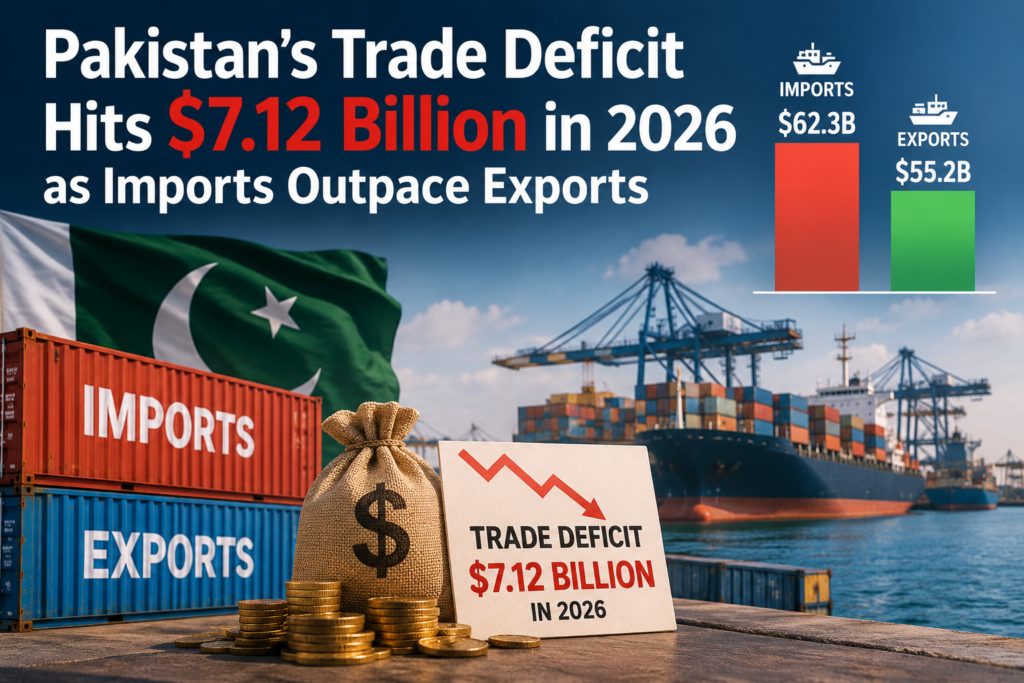
Pakistan’s trade deficit has widened significantly at the beginning of the new fiscal year, reaching approximately $7.12 billion during July–August 2026, according to the latest data released by the Pakistan Bureau of Statistics (PBS). The figure represents an increase of around 18.1% compared with the same period last year, when the trade deficit stood at approximately $6.03 billion. The latest numbers once again highlight one of Pakistan’s persistent economic challenges: the country continues to import substantially more goods than it exports.
The widening trade gap is particularly significant because of the different pace at which imports and exports are growing. During the first two months of FY2026–27, Pakistan’s imports increased by approximately 13% to $12.58 billion, compared with $11.13 billion during July–August 2025. Exports, meanwhile, rose by around 7% to $5.46 billion, from approximately $5.10 billion a year earlier. While export growth is certainly positive, it remains considerably slower than the increase in imports. This difference has been enough to push the cumulative trade deficit above the $7 billion mark.
According to the Pakistan Bureau of Statistics, the latest figures show that Pakistan’s external trade position remains under pressure despite some improvement in individual monthly numbers. The data also provides an important insight into the country’s broader economic situation: the problem is not necessarily that Pakistan’s exports are collapsing, but rather that exports are not expanding quickly enough to keep pace with import demand.
Despite the alarming headline figure, August 2026 brought a relatively positive development. Pakistan’s monthly trade deficit declined by almost 20%, falling from approximately $3.95 billion in July to around $3.17 billion in August. The improvement was primarily driven by a sharper decline in imports during the month. Imports fell by around 17.7% month-on-month to approximately $5.68 billion, while exports declined by around 15% to approximately $2.51 billion.

However, the monthly improvement needs to be viewed in context. Compared with August 2025, Pakistan’s trade deficit was still approximately 10.4% higher. This means that although the situation improved between July and August, the broader year-on-year trend remains concerning. The August figures therefore provide a positive short-term signal but do not yet demonstrate that Pakistan’s underlying trade imbalance has been resolved.
Business Recorder’s coverage of Pakistan’s trade deficit reports that the narrowing of the monthly deficit was largely associated with the decline in imports. For policymakers, the question now is whether this reduction will continue throughout the coming months or whether import growth will accelerate again as domestic economic activity increases.
Pakistan’s growing import bill is closely connected to the structure of its economy. The country remains dependent on international markets for energy, machinery, industrial raw materials, food products and other essential goods. As economic activity increases, demand for these imported products can also rise.
Not all imports are necessarily negative for the economy. Imported machinery and industrial inputs, for example, can increase productive capacity and help businesses expand. Energy imports are also essential for transportation, electricity generation and industrial production. The real concern emerges when imports continue increasing faster than the country’s ability to generate foreign exchange through exports and other sustainable sources.
International commodity prices can further complicate the situation. Pakistan’s dependence on imported energy means that fluctuations in global oil prices can have a direct impact on the country’s import bill. When the international cost of energy rises, Pakistan can end up spending significantly more foreign currency even without a proportionate increase in the physical volume of imports.
Pakistan’s exports have increased during the first two months of FY2026–27, but their growth remains insufficient relative to imports. The approximately 7% increase in exports is a positive development, yet it falls significantly short of the 13% increase in imports.
This difference points towards a deeper structural issue in Pakistan’s economy. The country has traditionally relied heavily on sectors such as textiles, garments, rice, leather and other conventional exports. While these industries remain important, Pakistan needs to move towards a more diversified and higher-value export base if it wants to generate substantially greater foreign-exchange earnings.
Information technology and digital services, engineering products, pharmaceuticals, processed agricultural products and higher-value manufacturing all represent potential areas for export expansion. Pakistan’s growing technology and freelance economy also provides an opportunity to increase foreign-exchange earnings through services rather than relying exclusively on physical goods.
The challenge, however, is not simply identifying sectors with export potential. Pakistan also needs to address the underlying issues that affect competitiveness, including production costs, energy prices, access to financing, infrastructure, logistics, taxation and regulatory uncertainty. Without improvements in these areas, Pakistani businesses may struggle to compete with producers from other emerging markets.
A trade deficit becomes particularly important for Pakistan because imports require foreign currency. When a country purchases significantly more goods from abroad than it sells internationally, it needs other sources of foreign exchange to finance the difference.
For Pakistan, these sources include workers’ remittances, foreign investment, external financing and exports of services. Remittances have become particularly important in helping the country manage its external position. According to recent reporting, Pakistan received approximately $41.5 billion in remittances during FY2025–26, providing substantial support to the country’s foreign-exchange position.
However, remittances cannot permanently substitute for a competitive export sector. Remittances are an important source of foreign exchange, but sustainable economic growth also requires Pakistan to increase the amount of value it generates and sells to international markets.
This is why the latest trade figures need to be considered alongside Pakistan’s wider external financing requirements. Dawn’s analysis of the latest trade figures reported that Pakistan faces more than $26 billion in external debt-servicing obligations during FY2026–27. Maintaining sufficient foreign-exchange inflows will therefore remain critical for the country’s economic stability.
One possible response to a widening trade deficit is to restrict imports. Pakistan has used import controls at different points in the past to reduce pressure on foreign-exchange reserves. While such measures can reduce the import bill in the short term, they are not necessarily a sustainable long-term solution.
The reason is simple: many of Pakistan’s imports are essential for economic production. Machinery, raw materials, energy and industrial components support domestic businesses and employment. Excessive restrictions could therefore reduce economic activity rather than solve the underlying problem.
A more sustainable strategy would be to distinguish between imports that contribute to productive capacity and those that provide limited economic value. At the same time, Pakistan needs to create conditions that allow domestic industries to produce more competitively and increase their exports.
The objective should therefore not simply be “import less.” It should be “produce more, export more and import more productively.”
Whether Pakistan’s trade deficit continues to widen will depend largely on what happens during the remaining months of FY2026–27. The first two months provide a warning because imports have grown almost twice as quickly as exports. However, two months are not enough to determine the performance of the entire fiscal year.
The decline in the monthly deficit during August provides one reason for cautious optimism. If import growth remains controlled while export growth accelerates, the trade gap could become more manageable. On the other hand, if imports once again begin rising rapidly without a corresponding increase in exports, the cumulative deficit could become significantly larger.
Pakistan therefore needs to focus on accelerating export growth rather than relying primarily on short-term import restrictions. Expanding into higher-value industries, improving productivity, reducing business costs and developing new international markets will be essential to achieving this.
The $7.12 billion trade deficit is an important warning sign, but it should not automatically be interpreted as an economic crisis. The more important issue is the underlying relationship between Pakistan’s imports and exports.
The latest data shows that imports are growing faster than exports, creating a larger gap between the country’s foreign-currency expenditures and its merchandise export earnings. At the same time, August demonstrated that the deficit can narrow when import growth slows.
For Pakistan, the challenge now is to turn temporary improvements into a longer-term trend. The country needs an export sector capable of generating significantly greater foreign exchange, while imports should increasingly contribute to productive investment and economic growth.
Ultimately, Pakistan’s trade problem cannot be solved simply by restricting what enters the country. The sustainable solution lies in building what the world wants to buy from Pakistan.
A stronger export sector, greater economic diversification, competitive industries and a growing digital-services economy could help Pakistan reduce its vulnerability to external shocks. The $7.12 billion figure should therefore be viewed not merely as another economic statistic, but as a reminder of the structural reforms needed to make Pakistan’s external sector more resilient.
For Pakistan’s economy in 2026, the central question is no longer simply how to reduce imports. It is whether the country can make its exports grow faster than its import bill, and turn its growing economic potential into sustainable foreign-exchange earnings.
Pakistan’s trade deficit reached approximately $7.12 billion during July–August 2026, according to the latest data from the Pakistan Bureau of Statistics (PBS). This represents an increase of around 18.1% compared with the same period of the previous year.
Pakistan’s trade deficit increased primarily because imports are growing faster than exports. During July–August 2026, imports increased by approximately 13%, while exports grew by around 7%, creating a wider gap between the value of goods Pakistan imports and exports.
Pakistan’s merchandise imports reached approximately $12.58 billion during July–August 2026, compared with around $11.13 billion during the same period in 2025.
Pakistan’s merchandise exports stood at approximately $5.46 billion during the first two months of FY2026–27. This represents an increase of around 7% compared with the same period last year.
Yes. Pakistan’s monthly trade deficit decreased by approximately 19.7%, falling from around $3.95 billion in July to $3.17 billion in August 2026. However, the August deficit was still approximately 10.4% higher than August 2025.
Pakistan relies on imports for several essential areas, including energy, machinery, industrial raw materials, food products and other inputs. Rising domestic economic activity and international commodity prices can therefore increase the country's import bill.
A persistent trade deficit can place pressure on Pakistan’s foreign-exchange position and external account because the country needs foreign currency to pay for imports. The impact depends on whether exports, remittances, investment and other foreign-exchange inflows are sufficient to finance the gap.
Pakistan can reduce its structural trade deficit by increasing exports, diversifying its export base, improving industrial competitiveness and expanding higher-value goods and services. Developing sectors such as IT, engineering, pharmaceuticals, processed agriculture and value-added manufacturing could help increase foreign-exchange earnings.
Not necessarily. A trade deficit alone does not mean that an economy is in crisis. The more important concern is whether the deficit continues to widen and whether Pakistan has sufficient and sustainable foreign-exchange inflows to finance imports and meet its external obligations.
The latest data suggests that Pakistan’s key challenge is accelerating export growth while managing import growth. The improvement recorded in August is encouraging, but the year-on-year increase in the trade deficit shows that the broader imbalance remains a concern. The performance of exports and imports over the coming months will determine whether the trade gap continues to widen or begins to stabilize.