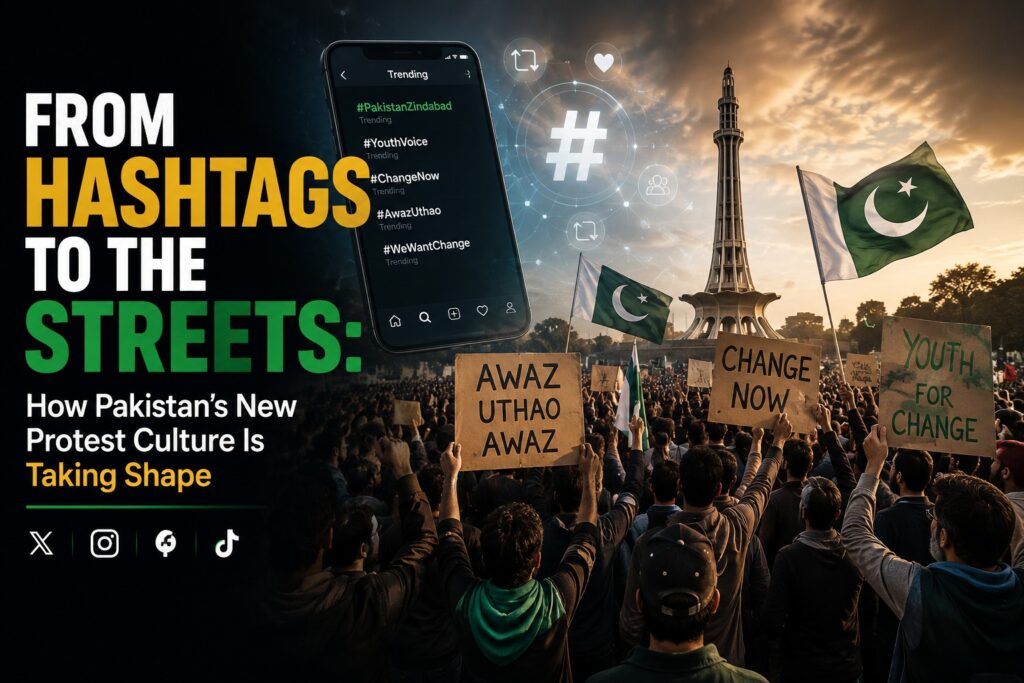
A protest in Pakistan does not always begin on a street anymore. Increasingly, it begins online, with a post, a video or a hashtag that brings an issue to the attention of thousands of people within a matter of hours. Recent public campaigns and demonstrations surrounding cases involving Mir Raza, Aizal and Muhammad Wali have once again highlighted how quickly individual incidents can develop into wider de mands for justice. On August 16, activists gathered outside the Karachi Press Club to demand justice in all three cases, while social media continued to keep public attention focused on them.
What makes these developments important is not simply the individual cases themselves, but what they reveal about the changing nature of public mobilisation in Pakistan. Social media has created a direct connection between an incident and the wider public, allowing families, activists and ordinary citizens to communicate their concerns without necessarily depending on political organisations or traditional media. As online campaigns increasingly move into physical demonstrations, Pakistan appears to be developing a new form of protest culture that is more digital, decentralised and increasingly influenced by younger generations.
Pakistan has a long history of protests, political movements and public demonstrations. For decades, large-scale mobilisation was generally associated with political parties, student groups, labour organisations, religious movements or established civil society organisations. These groups provided the leadership, resources and organisational structures required to bring people together.

The rise of social media, however, has changed the way an issue can gain public attention and how quickly people can organise around it.
Today, an individual does not necessarily need to belong to a political organisation to make an issue visible. A smartphone can be enough to document an incident, share a personal account or raise a question that thousands of other people may then amplify. This does not mean traditional forms of protest have disappeared; rather, online and offline activism are increasingly working together. A social-media campaign can create awareness before a demonstration, help coordinate supporters during a protest and keep public attention alive after people have returned home.
The transformation from an individual incident into a public movement can happen remarkably quickly. An incident is reported or discussed online, users begin sharing information and personal reactions, and a hashtag or campaign may emerge around demands for accountability. As the conversation grows, journalists and public figures may begin discussing the issue, giving it an audience far beyond the people who initially raised it. Eventually, the online conversation can translate into demonstrations outside press clubs, government offices or other public spaces.
This creates a new pattern of mobilisation in which the boundaries between social media activism and street protest are increasingly blurred. An issue can begin with a single post, gain momentum through thousands of shares, attract wider media attention and eventually become a physical demonstration. The internet provides the reach and speed, while traditional protests provide a visible form of public pressure.
The case involving Mir Raza has become one of the more visible examples of this changing dynamic. His death generated significant public attention, with Pakistani celebrities and activists publicly expressing support for his family and calling for justice. The case continued to attract attention beyond social media, with demonstrations and public demands placing greater focus on the investigation and the questions surrounding the circumstances of his death.
Public attention does not determine the outcome of a legal investigation, but sustained attention can make it considerably more difficult for a controversial case to disappear from public discussion. In Mir Raza’s case, authorities formed a new investigation team and removed a medico-legal officer following reported concerns regarding the initial post-mortem process. The development illustrates one of the ways in which sustained public pressure can encourage greater scrutiny, although the final determination of responsibility remains a matter for the relevant authorities and legal process.
The recent Karachi protest also brought the cases of Aizal and Muhammad Wali into the same public demonstration, with protesters gathering outside the Karachi Press Club to demand justice. Bringing several cases together in one demonstration reflects a broader tendency within contemporary activism: people often begin connecting separate incidents when they believe they represent a common concern about accountability, public safety or institutional response.
This changes the nature of the conversation. Instead of focusing exclusively on what happened to one individual, public debate can begin to ask broader questions about how institutions respond to citizens and whether existing mechanisms are providing people with sufficient confidence in the justice process. That shift can give individual campaigns a wider social dimension, although each case still needs to be assessed independently on the basis of verified evidence.
Pakistan’s young population is playing an important role in this transformation. For many young Pakistanis, social media is not simply a source of entertainment; it is also where they discover news, discuss social issues, follow public figures and express political opinions. Platforms such as Instagram, TikTok and X allow young users to participate in public conversations without having to be members of a political party or an established organisation.
This has created a different form of participation. A student can share information about a case, amplify a family’s appeal, support a campaign or help draw media attention to an issue from their phone. Young people may never attend a political rally, yet they can still contribute to a movement through their online activity. As a result, political and social participation is becoming less dependent on traditional organisational structures and more accessible to individuals.
The growing involvement of celebrities and influencers has added another dimension to Pakistan’s protest culture. A public figure with millions of followers can bring an issue to an audience that activists or individual families might otherwise struggle to reach. In the Mir Raza case, several Pakistani celebrities publicly supported calls for justice, helping keep the issue visible beyond the immediate circle of people involved.
However, influence also comes with responsibility. A large following can help spread verified information and draw attention to legitimate concerns, but it can also allow rumours or unverified claims to reach millions of people before they have been properly examined. For that reason, the involvement of public figures can be both a strength and a challenge for modern protest movements.
The same speed that makes social media powerful can also make it difficult to control misinformation. Unlike traditional news organisations, social-media users are not necessarily required to verify information before publishing it. A claim can therefore spread widely within minutes, while corrections may struggle to reach the same audience.
This creates a difficult balance between the right to demand accountability and the responsibility to avoid spreading unverified allegations. The Mir Raza case has also highlighted this tension, with authorities investigating aspects of the social-media campaign surrounding the case and individuals named in online allegations denying those claims. The broader lesson is that public pressure is most effective when it is built around credible information. Viral reach can bring attention to an issue, but it cannot by itself establish what actually happened.
When an issue attracts sustained online attention, receives media coverage and leads to public demonstrations, institutions may face greater pressure to explain their actions or demonstrate that concerns are being investigated. This does not mean every viral campaign produces an official response, nor does it mean that social media can replace courts, investigators or other institutions. Its influence lies primarily in its ability to make an issue visible and maintain public attention.
The difference between a temporary controversy and a sustained campaign often depends on what happens after the initial wave of outrage. Journalists may investigate further, lawyers may become involved, families may continue demanding answers and activists may organise additional demonstrations. In this sense, social media can provide the initial momentum, but long-term campaigns still require organisation, credibility and persistence.
One of the most interesting features of Pakistan’s emerging protest culture is that it can operate without a single central leader. Different groups and individuals can participate for different reasons while still gathering around a shared demand. This makes online movements relatively flexible and allows people who have never worked together before to become part of the same campaign.
However, decentralisation also creates challenges. Without clear leadership or an established structure, it can become difficult to establish common objectives, verify information or maintain consistency. A movement can attract enormous attention while still lacking a clear strategy for what should happen next. This is one of the major differences between digital mobilisation and traditional organised political movements.
Going viral can create visibility, but visibility is not necessarily the same as meaningful change. A hashtag may receive millions of views and still disappear within a few days without producing an investigation, legal action or policy response. At the same time, sustained online attention can sometimes become the starting point for more substantial developments when it encourages journalists to investigate, institutions to respond or citizens to organise offline.
The real measure of digital activism is therefore what happens after something trends. If an online campaign leads to credible investigation, sustained advocacy, legal proceedings or greater institutional accountability, social media becomes more than a space for public outrage. It becomes a mechanism through which citizens can place pressure on existing systems.
The growing influence of online activism presents a complicated challenge for Pakistan’s institutions. Public dissatisfaction can now become visible far more quickly, and authorities cannot assume that an issue will remain limited to one locality or a small group of people. At the same time, governments have a responsibility to address misinformation and prevent false claims from causing harm.
The most effective response is likely to involve transparency rather than simply attempting to control the conversation. When institutions provide timely information, explain their decisions and demonstrate that legitimate complaints are being investigated, there is less space for rumours to fill the information gap. If legitimate concerns are ignored, however, online frustration can become stronger and eventually spill over into physical demonstrations.
For young Pakistanis, digital activism has created a new form of civic participation. Someone sitting in Karachi, Lahore, Islamabad or Peshawar can contribute to a national conversation without physically travelling to a demonstration. They can share a family’s appeal, highlight a case, support a campaign or draw attention to an issue that might otherwise receive limited coverage.
With that influence comes responsibility. Participating in a digital campaign is not simply about sharing the most emotional post or the most widely circulated video. Responsible activism also requires checking sources, understanding context and distinguishing between confirmed information and allegations. Pakistan’s young population has considerable power to shape public conversations, and the way that power is used will determine whether digital activism becomes a constructive force for accountability or simply another source of online outrage.
The new protest culture also carries serious risks. Online campaigns can turn into harassment, unverified allegations can damage reputations and political groups can attempt to use genuine public anger for their own purposes. There is also the risk of protest fatigue, particularly when one controversy quickly replaces another and public attention moves on before a serious issue has been properly resolved.
For digital activism to produce meaningful change, therefore, visibility alone is not enough. Successful campaigns need credible information, clear demands, responsible communication and persistence. The ability to make something trend is powerful, but the ability to keep attention focused on an issue until there is a meaningful institutional response is much harder.
Pakistan’s protest culture is unlikely to return to the way it looked before social media became central to everyday life. The tools have permanently changed how citizens communicate, organise and express dissatisfaction. A smartphone can document an incident, a hashtag can bring national attention to it, a celebrity can amplify the message and a digital campaign can eventually lead people into the streets.
The real question is what happens after that mobilisation begins. If institutions respond transparently, investigate credible complaints and communicate clearly, social media can become a constructive mechanism for accountability. If legitimate concerns are repeatedly ignored, however, online anger may continue to develop into physical protests and broader movements. Pakistan is therefore not simply witnessing a change in how people protest; it is witnessing a change in how public pressure itself is created.
Pakistan’s protest culture is entering a new phase in which the street and the smartphone are no longer separate spaces. Recent cases involving Mir Raza, Aizal and Muhammad Wali demonstrate how individual incidents can attract wider public attention, generate social-media campaigns and eventually contribute to physical demonstrations demanding justice.
The power of this new model lies in its accessibility. Ordinary citizens can now bring an issue into the national conversation without necessarily having the resources or organisational backing that traditional movements required. At the same time, that power comes with an equally important responsibility to verify information and avoid turning allegations into facts simply because they have gone viral.
For Pakistan’s young and increasingly connected population, social media is becoming more than a communication tool. It is becoming a space where public opinion is formed, accountability is demanded and movements can take shape. The question is no longer whether hashtags can influence the streets. They already do. The bigger question is whether that influence can translate into lasting, responsible and meaningful change.