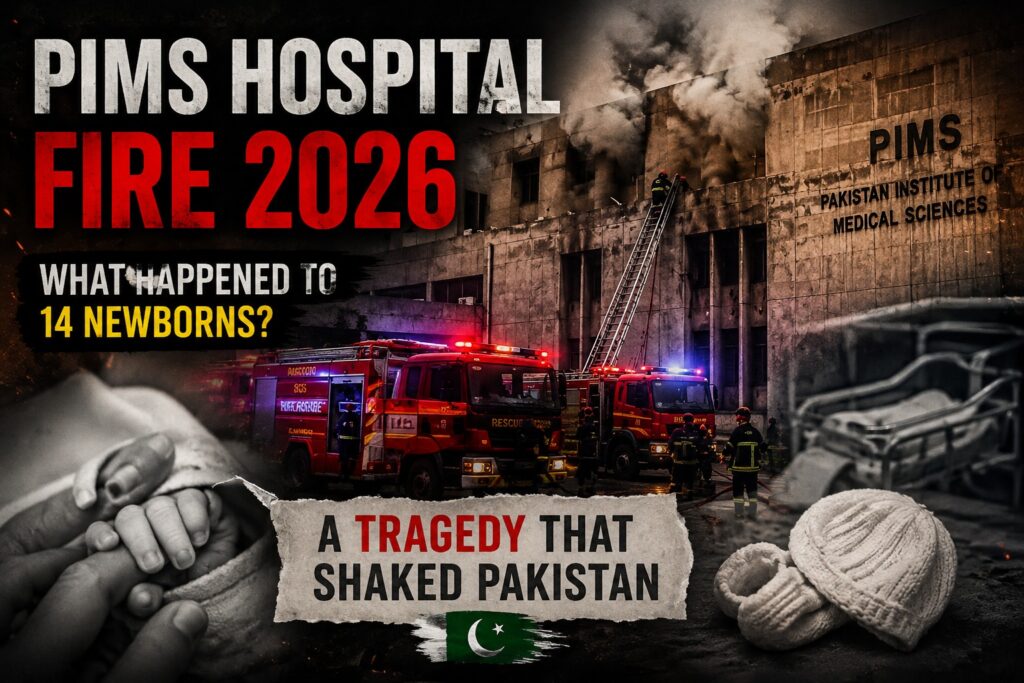
A fire at the Pakistan Institute of Medical Sciences (PIMS) in Islamabad on August 26, 2026, killed 14 newborn babies, turning a routine morning at one of the capital’s largest public hospitals into one of Pakistan’s most devastating recent hospital tragedies.

A fire at the Pakistan Institute of Medical Sciences (PIMS) in Islamabad on August 26, 2026, killed 14 newborn babies, turning a routine morning at one of the capital’s largest public hospitals into one of Pakistan’s most devastating recent hospital tragedies. The fire broke out in the Mother and Child Health facility, where newborns were receiving intensive care, and only one of the 15 babies reportedly present in the nursery was rescued.
The tragedy has since raised much bigger questions than the immediate cause of the fire. Families are demanding answers about the hospital’s fire-safety arrangements, emergency response and the conditions inside the neonatal facility, while the government has ordered an investigation into what happened. Prime Minister Shehbaz Sharif has also ordered action at the federal health ministry, and an inquiry committee has been constituted to establish the circumstances surrounding the deaths.
The fire broke out at approximately 6:45–7:00am on August 26 in the gynaecology/Mother and Child Health area of PIMS. According to hospital officials and government statements, 15 newborns were in the affected nursery when the fire began. Fourteen subsequently died, while one infant was rescued. Firefighters and rescue teams were dispatched to the hospital, and the fire was eventually brought under control.

The nursery was particularly vulnerable because the babies were either in incubators or dependent on oxygen support. Reports from the scene described thick smoke and difficult evacuation conditions, with rescue personnel using ladders and accessing the affected area through windows after the fire spread through the nursery. The rest of the hospital was not engulfed by the blaze, but the consequences inside the neonatal area were catastrophic.
The exact cause remains subject to investigation, and this is an important distinction because initial official accounts have not been completely consistent.
Health Minister Mustafa Kamal said the fire was caused by a blast in an air-conditioning unit, while other initial reporting from PIMS officials and government representatives referred to a possible short circuit. Radio Pakistan later reported that initial findings pointed towards a short circuit. Until the formal inquiry establishes the cause, it would be premature to treat either explanation as conclusively proven.
The investigation is therefore expected to look not only at what triggered the fire but also at why it spread so rapidly, whether the nursery had adequate fire-safety equipment and whether the hospital’s emergency procedures were sufficient for a facility caring for critically ill newborns.
The situation inside the nursery was particularly challenging because newborns in intensive care cannot simply be evacuated like ambulatory patients. Many require incubators, oxygen and continuous medical support, meaning that even a rapid evacuation requires trained staff, equipment and a clearly designed emergency procedure.
Reports from families and witnesses have also raised allegations about access and evacuation routes inside the affected area, including claims that doors or exits were locked. These are allegations rather than established findings, and the investigation will need to determine whether access restrictions contributed to the deaths.
That distinction matters. In a tragedy of this scale, public anger is understandable, but questions surrounding negligence, locked exits or delayed response need to be established through evidence rather than assumptions.
The government moved quickly after news of the deaths emerged. Prime Minister Shehbaz Sharif ordered an immediate investigation and constituted a high-level inquiry committee to examine the incident. Former interior secretary Shahid Khan was appointed to head the committee, which was tasked with determining what caused the fire and whether safety procedures were properly implemented.
The government has also taken administrative action. The federal health secretary was suspended following the tragedy, while Health Minister Mustafa Kamal said he would personally oversee the investigation and that those found responsible would face accountability.
The tragedy has inevitably turned attention towards fire safety at public hospitals. A hospital is expected to be one of the safest places in a city, particularly for patients who cannot protect or evacuate themselves. A neonatal intensive-care facility presents an even greater responsibility because newborns depend almost entirely on medical staff and equipment for survival.
The PIMS incident has therefore raised questions about whether emergency exits, fire alarms, extinguishing systems, electrical infrastructure, evacuation plans and staff training were adequate. These are precisely the areas the inquiry committee will need to examine if the investigation is to provide more than a simple explanation of how the fire started.
PIMS is not an ordinary private clinic. It is one of Islamabad’s principal public-sector hospitals and serves a large number of patients from the capital as well as surrounding regions. For many families, public hospitals such as PIMS are the only realistic option for specialised and affordable medical treatment.
That makes the tragedy particularly significant. When people take their newborn children to a major public hospital, they are placing an enormous amount of trust in the institution. The deaths at PIMS have therefore created not only grief but also a serious public conversation about whether Pakistan’s major healthcare facilities are adequately prepared for emergencies.
The figure 14 can easily become another statistic in a news cycle, but each of those numbers represents a newborn who had only just entered the world and a family that expected to take a child home.
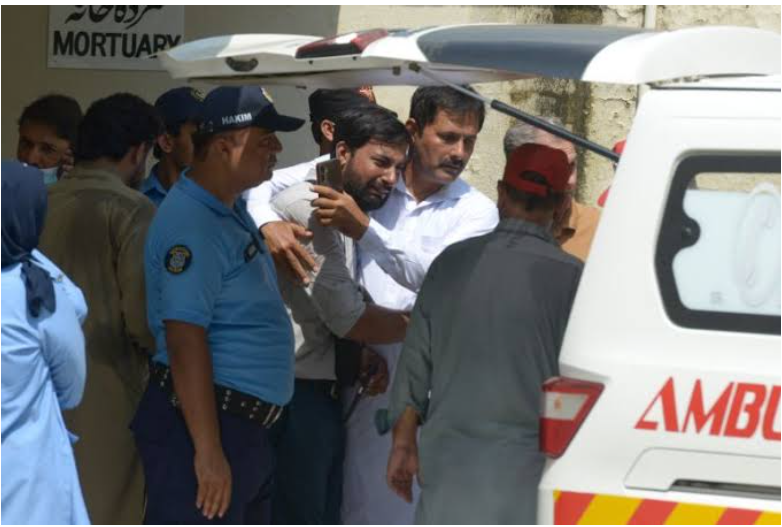
Parents and relatives gathered outside PIMS as the scale of the tragedy became clear, with several families demanding answers and accountability. Reports from the hospital described scenes of grief and anger as relatives waited for information about their children.
For these families, an inquiry is not simply about identifying a technical fault. They want to know whether the deaths could have been prevented and whether someone failed in a responsibility that was entrusted to them.
The PIMS tragedy has also reopened a wider debate about fire safety in Pakistan’s public buildings. A review published by Dawn following the incident highlighted a history of hospital fires across the country and pointed towards recurring problems involving building standards, fire-safety regulations and weak enforcement.
That makes the PIMS investigation important beyond Islamabad. If the inquiry identifies failures in electrical maintenance, evacuation planning, fire equipment or emergency preparedness, the findings should ideally lead to safety audits across other hospitals rather than remaining limited to one institution.
Neonatal units cannot be treated like ordinary hospital wards. Newborns may be unable to breathe independently, move without assistance or survive outside specialised equipment. A fire-safety plan designed for ordinary hospital rooms may therefore not be sufficient for a neonatal intensive-care environment.
Hospitals need emergency systems that account for these realities, including accessible exits, backup power, fire detection, emergency oxygen procedures, trained staff and evacuation equipment specifically suited to infants. The PIMS tragedy has highlighted why these safeguards cannot be treated as administrative details.
The government’s response will ultimately be judged not by how quickly statements were issued but by what happens after the investigation.
If negligence is established, families and the public will expect those responsible to face meaningful consequences. If the investigation finds that the fire resulted from an unforeseeable equipment failure despite adequate safety procedures, that conclusion should also be supported by transparent evidence.
Either way, the credibility of the inquiry will depend on its independence, evidence and willingness to address uncomfortable questions about hospital management and safety standards.
One possible outcome of the tragedy is a nationwide review of fire safety in hospitals, particularly facilities with intensive-care and neonatal units. Hospitals could be required to conduct regular electrical inspections, test fire alarms and extinguishing systems, verify that emergency exits remain accessible and conduct evacuation drills for high-risk wards.
The incident could also encourage authorities to establish clearer accountability for safety compliance. Fire safety cannot be the responsibility of one department alone; hospital administrations, engineering teams, health authorities and emergency services all have roles to play.
Modern healthcare is not only about doctors, medicines and medical equipment. It also depends on infrastructure that can protect patients when something goes wrong.
A hospital may have highly trained doctors, but those capabilities become irrelevant if a fire prevents medical staff from reaching patients or if evacuation systems fail. Emergency preparedness therefore needs to become part of everyday hospital management rather than something reviewed only after a disaster.
The PIMS fire has exposed a difficult reality about Pakistan’s healthcare system: protecting patients requires much more than providing treatment. Hospitals also need safe buildings, functioning infrastructure, trained emergency teams and systems designed around the needs of the most vulnerable patients.
The deaths of 14 newborns have therefore become a national public-safety issue. The tragedy deserves grief and compassion, but it also requires scrutiny. The central question is not only how the fire started, but whether the systems that were supposed to protect those babies worked when they were needed most.
The immediate focus will remain on the investigation into the PIMS fire. Authorities will need to establish the precise cause, determine how the fire spread, examine the hospital’s fire-safety arrangements and assess the response of staff and emergency services.
The larger question is what happens after those findings are released. If the investigation produces recommendations but hospitals return to business as usual, the tragedy will have produced little institutional change. If it leads to meaningful safety reforms across public hospitals, however, the deaths of the 14 newborns could become a catalyst for preventing similar tragedies in the future.
The PIMS Hospital Fire of 2026 has left 14 families facing an unimaginable loss and has raised serious questions about safety in one of Islamabad’s most important public hospitals. Fourteen newborns died after a fire swept through the Mother and Child Health facility, while one infant was rescued. The government has ordered a high-level investigation, suspended the federal health secretary and promised accountability for those found responsible.
The cause of the fire is still being investigated, with early reports pointing to both an air-conditioning failure and a possible short circuit. Other questions surrounding evacuation, emergency response and fire-safety arrangements also remain to be answered.
For the families who lost their children, no investigation can undo what happened. But a transparent inquiry can establish responsibility, and meaningful reforms can ensure that another family does not have to experience the same tragedy.
The real measure of the response to PIMS will not be the statements made after the fire. It will be whether Pakistan’s hospitals become safer because of it.