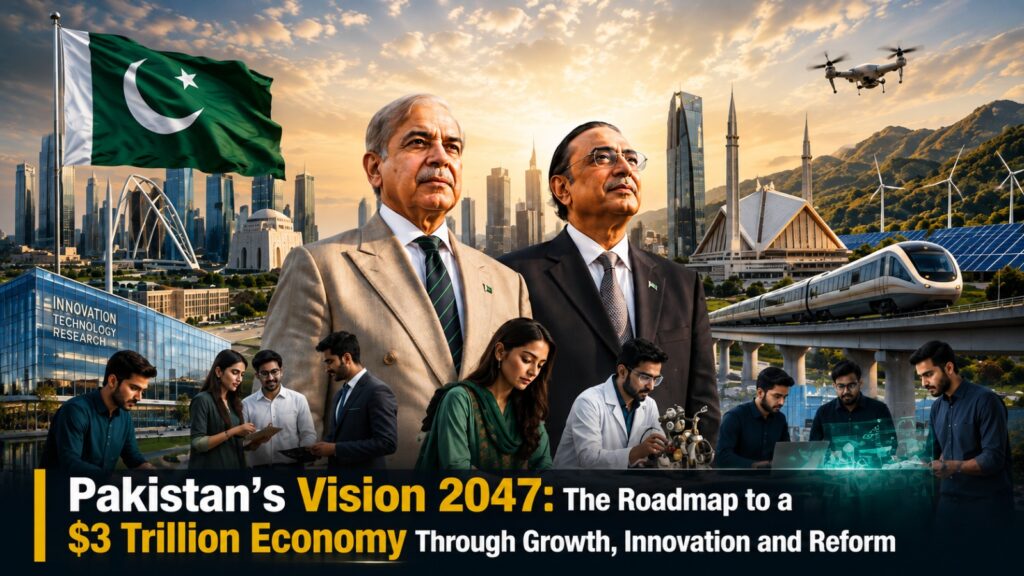
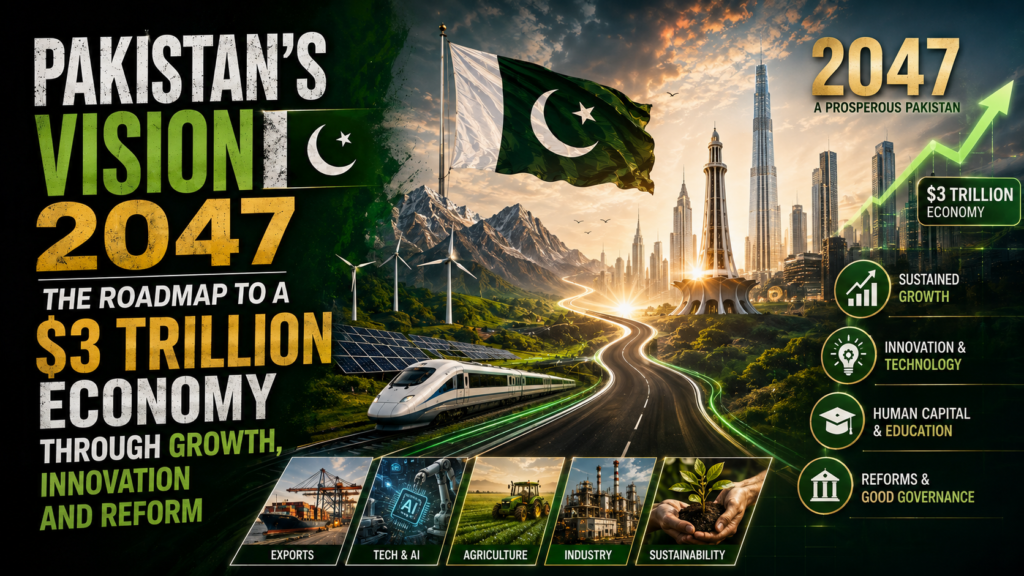
Pakistan is looking toward a very different economic future by the time the country reaches its centenary in 2047. The government has set an ambitious long-term objective of transforming Pakistan into a $3 trillion economy by 2047, with an earlier milestone of reaching $1 trillion by 2035. The strategy behind these targets is centred on exports, technology, innovation, investment, human capital, infrastructure and structural reforms.
The immediate vehicle for this transformation is URAAN Pakistan, the government’s Five-Year National Economic Transformation Plan for 2024–29. Built around the 5Es, Exports, E-Pakistan, Equity & Empowerment, Environment & Climate Change, and Energy & Infrastructure, the plan is intended to move the economy away from repeated cycles of low growth and external financing pressures towards a more productive and competitive model.
But the numbers themselves are only one part of the story. The more important question is whether Pakistan can make the reforms needed to turn its existing potential, its young population, geographic position, natural resources, businesses and growing technology sector, into sustained economic growth.
Pakistan’s Vision 2047 is a long-term development ambition linked to the country’s 100th anniversary of independence. The government’s broader objective is to build a more prosperous, technologically advanced and globally competitive Pakistan by 2047.

URAAN Pakistan provides a near-term policy framework for moving towards that objective. The government describes it as a Five-Year National Economic Transformation Plan designed to establish the foundation for a $3 trillion techno-economy by 2047.
The plan is therefore not simply about increasing GDP. It is about changing the structure of the economy — increasing exports, improving productivity, expanding digitalisation, developing human capital, strengthening infrastructure and making Pakistan more attractive for investment.
The government’s roadmap includes a major intermediate target: a $1 trillion economy by 2035.
In February 2026, Planning Minister Ahsan Iqbal presented two possible economic trajectories for Pakistan. Under a slower, business-as-usual path, the economy could reach roughly $600 billion by 2035. Under a transformational path involving stronger governance and reforms, the government believes the $1 trillion milestone could be achieved.
This distinction is important because it shows that the $1 trillion figure is not being presented as an automatic economic forecast. It is an ambitious target dependent on reforms, productivity and sustained growth.
The longer-term goal is even more ambitious: reaching approximately $3 trillion by 2047.
URAAN Pakistan is organised around five major pillars known as the 5Es: Exports, E-Pakistan, Equity & Empowerment, Environment & Climate Change, and Energy & Infrastructure.
Together, these pillars cover many of the structural issues that have traditionally constrained Pakistan’s economy. Exports are intended to generate foreign exchange, digitalisation is expected to improve productivity, human development should strengthen the workforce, climate policies aim to improve resilience, while energy and infrastructure are essential for industrial and economic expansion.
The strength of the framework will ultimately depend on whether these areas can be developed together rather than treated as separate government programmes.
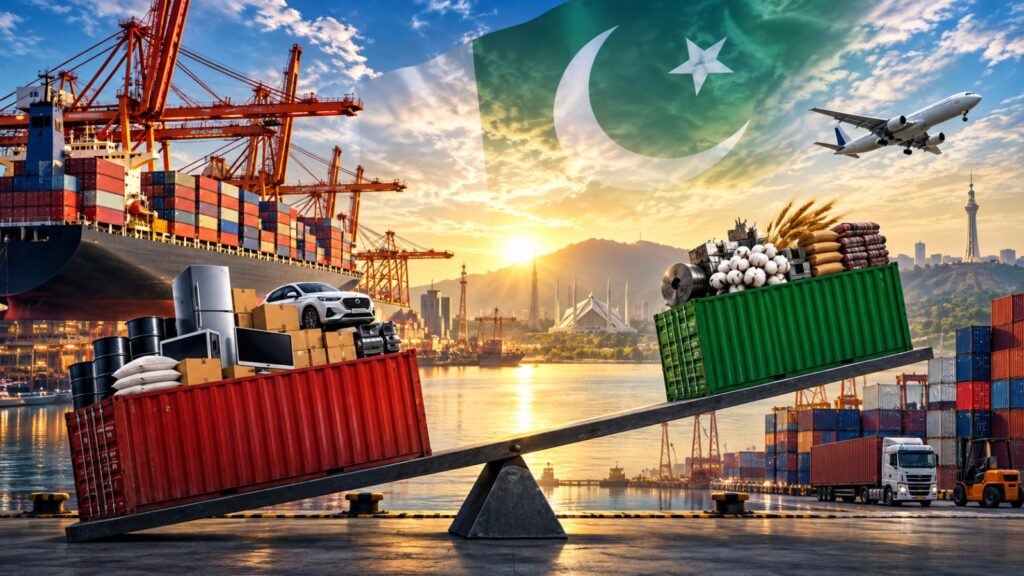
Pakistan’s repeated balance-of-payments problems have demonstrated why exports matter. When imports rise faster than export earnings, pressure builds on foreign-exchange reserves and the country becomes increasingly dependent on external financing.
The government therefore wants exports to become a central driver of growth. Its strategy includes expanding beyond traditional sectors and increasing the contribution of information technology, agriculture, manufacturing, pharmaceuticals, minerals, tourism, the blue economy and creative industries.
The larger objective is not simply to export more products. Pakistan needs to move towards higher-value exports that generate greater foreign exchange and allow local companies to compete more effectively in international markets.
Digitalisation is another major component of the economic transformation plan.
Pakistan already has a growing technology and freelance economy, but the government’s ambition is to move beyond individual freelancers and basic digital services towards a much larger technology ecosystem involving startups, software companies, artificial intelligence, e-commerce, fintech and other digital industries.
The official URAAN framework includes targets related to ICT freelancing and digital transformation, reflecting the government’s belief that technology can become a major source of employment and export earnings.
For Pakistan, the attraction is clear. Digital services can reach international markets without requiring the same physical infrastructure needed by many traditional industries. A Pakistani company can develop software in Lahore, Islamabad or Karachi and sell it to customers anywhere in the world.
The challenge is creating enough companies capable of doing that at scale.
Artificial intelligence is rapidly changing the global economy, and Pakistan is attempting to position itself for that shift.
Government officials have increasingly identified technology, AI, innovation, entrepreneurship and skilled human capital as important components of the country’s economic transformation.
For Pakistan, AI presents both an opportunity and a challenge. The opportunity lies in using AI to improve productivity across sectors such as finance, agriculture, healthcare, education, manufacturing and government services. The challenge is ensuring that Pakistani workers and businesses have the skills and infrastructure needed to actually use these technologies.
If Pakistan can build a strong AI-skilled workforce, the country’s large young population could become an economic advantage rather than simply a demographic statistic.
Pakistan’s young population is frequently described as one of its greatest economic assets. Government figures indicate that more than 65% of the population is under the age of 30.
But demographics alone do not create economic growth. A young population becomes an advantage when people have access to quality education, relevant skills, productive employment and opportunities to participate in the economy.
That is why human capital is central to the Vision 2047 discussion. Pakistan will need engineers, researchers, entrepreneurs, technology professionals, skilled workers, healthcare professionals and other specialists capable of contributing to a modern economy.
The real demographic opportunity is therefore not simply having millions of young people. It is turning those millions into a highly productive workforce.
A technology-driven economy requires an education system that keeps pace with changing labour markets.
The government has been calling for universities and higher education institutions to focus more heavily on emerging fields, research, innovation, entrepreneurship and skills that match future economic requirements.
For students, this could increasingly mean that a degree alone will not be enough. Employers will place greater value on practical skills, problem-solving, digital literacy, creativity and the ability to work with emerging technologies.
If Pakistan wants to become a knowledge-based economy, its universities will need to become important centres of research and innovation rather than institutions focused primarily on producing graduates.
No country can industrialise or digitalise effectively without reliable and affordable energy.
Pakistan’s energy sector has faced longstanding problems involving high costs, inefficiencies and circular debt. These challenges affect households, but they also raise the cost of doing business and make Pakistani exports less competitive.
Energy and Infrastructure therefore form one of the five pillars of URAAN Pakistan. The government’s roadmap includes increasing renewable energy and improving energy efficiency as part of the longer-term transformation.
For Pakistan, energy reform is not simply an environmental issue. It is directly connected to industrial competitiveness, investment and economic growth.
Pakistan’s economic future cannot be separated from climate change.
Floods, extreme temperatures, water shortages and other climate-related risks can damage infrastructure, reduce agricultural productivity and place additional pressure on public finances.
That is why Environment & Climate Change is one of URAAN Pakistan’s five pillars. The government’s framework includes targets related to reducing projected emissions and increasing renewable energy capacity.
For Pakistan, climate resilience should therefore be viewed as part of economic planning rather than as a separate environmental agenda.
Agriculture remains a critical part of Pakistan’s economy, but simply increasing production is not enough.
The greater opportunity lies in improving productivity, modernising irrigation, reducing post-harvest losses and developing processing and storage facilities. Pakistan can also generate more value by exporting processed and branded agricultural products instead of relying primarily on raw commodities.
Technology could accelerate this transition through precision agriculture, digital marketplaces, improved supply-chain management and better access to information.
A more productive agricultural sector would not only support food security but could also strengthen Pakistan’s export base.
Pakistan’s industrial sector has traditionally relied heavily on textiles and a relatively narrow group of export products.
That makes diversification important.
The country has opportunities in pharmaceuticals, engineering, food processing, minerals, technology-related manufacturing and other higher-value industries. But developing these sectors will require investment in machinery, research, skills and infrastructure.
Pakistan’s long-term economic objective is therefore not just to manufacture more. It is to manufacture more competitively and move towards higher-value production.
The first test is not 2047.It is 2030 and 2035.
The government has established nearer-term targets under URAAN Pakistan, including stronger GDP growth, increased exports, expansion of ICT freelancing, greater renewable-energy adoption and improvements in social and economic indicators.
These milestones will provide a much better indication of whether the broader Vision 2047 strategy is working.
If Pakistan can consistently meet intermediate targets, attract investment, increase exports and improve productivity, the $3 trillion ambition will become more credible.
If reforms repeatedly stall, the gap between the vision and reality will remain.
Pakistan’s Vision 2047 is ultimately a bet on economic transformation.
The government wants to build a $1 trillion economy by 2035 and a $3 trillion economy by 2047, using URAAN Pakistan as the immediate framework for achieving that transformation. Its strategy rests on exports, digitalisation, human development, climate resilience, energy, infrastructure and structural reform.
But the biggest challenge is not setting ambitious numbers.
It is creating the conditions that allow those numbers to become achievable.
Pakistan will need stronger institutions, better governance, reliable energy, modern infrastructure, an education system aligned with future skills, greater private investment and a much more competitive export sector.
By 2047, Pakistan will mark 100 years of independence.
The real question is whether it will also mark the moment when its economic potential finally became economic performance.
Vision 2047 is not simply about building a bigger economy. It is about changing the way Pakistan grows.