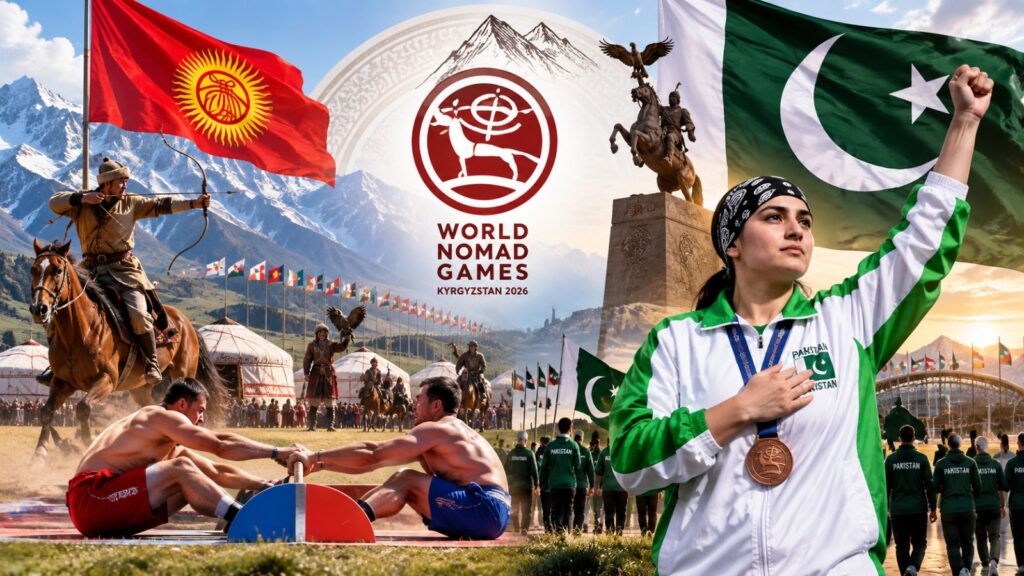
Over six days in Bishkek and Cholpon-Ata, Pakistan’s flag was displayed next to those of over a hundred countries at the VI World Nomad Games, a biennial event in Kyrgyzstan that honors traditional and indigenous sports. This was not an Olympic-style campaign that grabbed headlines, and it was not intended to be one. However, the Games gave Pakistan something it seldom experiences on the global sports scene: a type of competition where its own cultural heritageincluding wrestling techniques, tug-of-war, and horsemanshipis the central focus rather than a side attraction.
Pakistan came back with four bronze medals. At first glance, that is a fairly unimpressive count. Upon closer examination, it reveals something more intriguing about the current state of the country’s sporting identity and its potential future direction.
The World Nomad Games were launched in 2014 in Kyrgyzstan as a venue for ethnic and traditional sports practiced across Central Asia and further afield, and it has expanded consistently ever since. The 2026 edition, the sixth overall and the fourth hosted by Kyrgyzstan,

took place in both the capital Bishkek and the lakeside town of Cholpon-Ata from August 31 to September 6, attracting athletes from over one hundred nations competing in numerous disciplines, ranging from horseback wrestling and eagle hunting to archery and tug of war. In contrast to the Olympics or Asian Games, this event is specifically designed to preserve traditional, often region-specific sports on an international stagewhich is exactly why Pakistan’s involvement carries a significance that differs from a typical multi-sport competition.
Pakistan sent around 100 athletes and officials to Bishkek, taking part in traditional and indigenous events that featured equestrian sports, mas wrestling, tug of war, and archery. Beyond the competitions, the team also performed showcase displays of Kabaddi, Kite Flying, Desi Kushti, and NaizaBazi (tent-pegging), activities that have strong roots in Pakistan’s rural and regional traditions. The Traditional Sports & Games Pakistan Association (TSGPA) oversaw the training process, with a send-off event taking place at the National Coaching Centre in Lahore before the squad departed for Kyrgyzstan.
Notably, the team’s preparation reflected a more organized approach compared to previous years. TSGPA assigned a dedicated sports psychologist to the squad ahead of the Games, indicating that Pakistan’s traditional-sports community is starting to adopt methods long used in mainstream competitive sport mental conditioning, structured coaching, and corporate support instead of depending solely on natural athletic ability.
Pakistan’s four medals were earned in just two sports. In tug of war, Tayyab Raza Awan secured a bronze in the 1×1 event after overcoming rivals from Russia, Georgia, and the UK, and then defeating his Iranian opponent in the bronze medal match. Pakistan’s tug-of-war squad also took bronze in the 8×8 team event, competing against India, the UK, Russia, South Korea, Kazakhstan, Kyrgyzstan, Brazil, and Georgia throughout the tournament before narrowly beating Iran for third place.
In mas wrestling, Muhammad Asim captured bronze in the 90kg category following a tight battle with an Iranian wrestler, while IqraNaseeb added a fourth medal for Pakistan with a bronze in the women’s 90kg-plus division, also against an Iranian rival. Notably, Iran was the opponent Pakistan had to beat in three of its four medal matches highlighting how strong the Central and South Asian wrestling and strength-sport tradition is at this competition.
Four bronze medals will not lift Pakistan in any global sports rankings. However, the real importance of this campaign goes beyond the medal table and lies in what it stands for: international recognition for sports that seldom receive attention back home. Tug of war and mas wrestling are absent from Pakistan’s usual sports discussions, which focus on cricket and increasingly on hockey, squash, and athletics. The Nomad Games offered athletes in lesser-known sports a genuine opportunity to represent their country and secure achievements.
There is also a cultural aspect that holds significance beyond the scoreboard. Sports such as Desi Kushti, Kabaddi, and NaizaBazi are living traditions in parts of rural Punjab, Sindh, and Khyber Pakhtunkhwa, yet they have limited formal international platforms. An event designed specifically for this type of sport provides Pakistan a rare opportunity to display heritage that conventional multi-sport competitions would not accommodate.
The amount of political attention that the Games received in Pakistan was significant. Prime Minister Shehbaz Sharif openly wished the Pakistani team success before the event, and senior sports officials, including the Pakistan Sports Board leadership, were actively engaged in backing the Traditional Sports Federation’s preparations. Following the medal wins, the President, the Prime Minister, and the Pakistan Sports Board all praised the athletes and organizers for the honor they brought to the nation. Such a high level of top-tier involvement, for a fairly low-profile multi-sport event, indicates that the government sees worth in traditional-sports diplomacy that extends beyond just counting medals.
Pakistan’s sporting narrative is typically framed around cricket’s ups and downs, while traditional sports are often mentioned only as an afterthought. The Nomad Games campaign highlights a quieter, parallel path: a modest but growing institutional push to professionalize and internationalize sports that were once confined to casual village contests. The involvement of a sports psychologist, corporate sponsorship noted by TSGPA, and a structured selection and preparation process for a delegation of one hundred athletes are small yet tangible indicators of this change.
The real issue is whether this will lead to sustained investment. A successful performance at a single Nomad Games event does not, on its own, secure ongoing funding or interest for wrestlers, tug-of-war athletes, or tent-pegging competitors once the next cricket season or Asian Games cycle dominates public attention. In Pakistani sport, the common pattern is a short-lived wave of excitement around a particular event, followed by long stretches without support until the next opportunity emerges.
If Pakistan wants its Nomad Games performance to be more than a fleeting headline, several things would need to happen: ongoing funding for traditional sports federations between Games cycles, more domestic tournaments in events like mas wrestling and tug of war to develop a stronger talent pool, and continued application of modern sports-science supportthe kind TSGPA introduced this yearrather than viewing it as a one-off addition before a single competition.
The advantage is that Pakistan already possesses what many countries at this event lack: vibrant, ongoing traditions in precisely the sports that the Nomad Games highlights. The foundation is already in place. What happens next hinges on whether that foundation receives sustained backing or recedes into the background until the next international event arises.
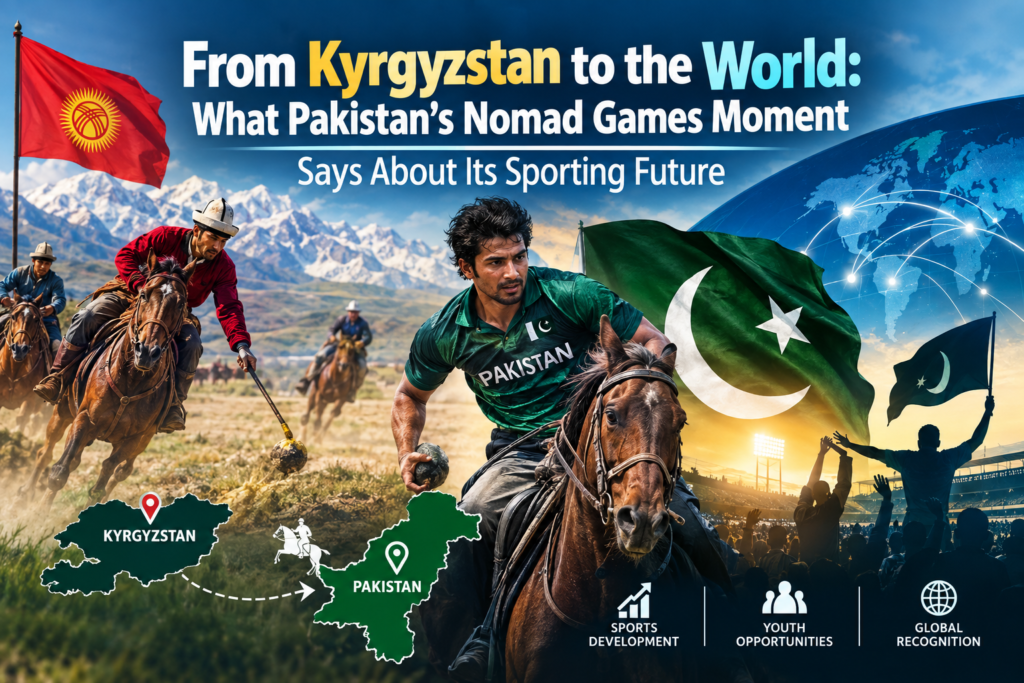
Pakistan’s journey back from Kyrgyzstan concluded with four bronze medals a modest tally by medal-table standards, yet meaningful for the athletes and sports involved. The more significant narrative goes beyond the podium, focusing on what the campaign reveals: a traditional-sports ecosystem in Pakistan that is gradually professionalizing, gaining high-level political attention, and discovering an international platform that matches its strengths. The Nomad Games moment will not instantly transform Pakistan’s sporting image, but it offers a hint of a sporting future that extends beyond cricket provided the momentum from Bishkek is not allowed to dissipate once the athletes return home.
Pakistan won four bronze medals — two in tug of war (1x1 and 8x8 team events) and two in mas wrestling (men's 90kg and women's 90kg-plus).
Tayyab Raza Awan and the national tug-of-war team won bronze in tug of war, while Muhammad Asim and IqraNaseeb won bronze in mas wrestling.
Pakistan's competitive delegation took part in equestrian sports, mas wrestling, tug of war and archery, while also staging showcase demonstrations of Kabaddi, Kite Flying, Desi Kushti and NaizaBazi.
The Games were held in Kyrgyzstan, with the opening and closing ceremonies in Bishkek and the main competitions in Cholpon-Ata, from August 31 to September 6, 2026.
Pakistan sent around 100 athletes and officials to the Games, led by Chairman and Head of Delegation Nawab Furqan Khan and Chef de Mission Muhammad Shahid.
The Traditional Sports & Games Pakistan Association (TSGPA), with support from the Pakistan Sports Board, organised and prepared Pakistan's contingent for the Games.
The campaign highlighted Pakistan's living traditions in sports like tug of war, wrestling and tent-pegging, and showed early signs of a more structured, professionalised approach to traditional sports, including the appointment of a dedicated sports psychologist for the squad.