Pakistan’s startup ecosystem is gaining remarkable momentum in 2026, emerging as one of Asia’s fastest-growing entrepreneurial markets. With a reported 62.2% annual growth in its startup ecosystem, Pakistan has attracted growing attention for the pace at which its technology and innovation landscape is developing. The country’s progress reflects a broader shift towards digital entrepreneurship, fintech, e-commerce, information technology and technology-enabled services.
The development is particularly significant for Pakistan because its startup ecosystem is still relatively young compared with established markets across Asia. Pakistan currently ranks 67th globally and second in South Asia in StartupBlink’s overall startup ecosystem ranking. The rapid growth therefore represents momentum rather than an indication that Pakistan has already reached the scale of Asia’s largest startup hubs.
For a country with a young population, a growing technology workforce and an expanding digital economy, this momentum could become an important driver of future economic growth.
According to StartupBlink’s 2026 data, Pakistan’s startup ecosystem recorded 62.2% annual growth, highlighting the rapid expansion of entrepreneurial activity across the country. The index evaluates startup ecosystems through broader indicators rather than simply counting the number of newly established companies.

This means the 62.2% figure should not be interpreted as Pakistan creating 62.2% more startups in a single year. Instead, it reflects significant improvement in the overall ecosystem measured by StartupBlink.
The growth is nevertheless important because it indicates that Pakistan’s entrepreneurial environment is becoming increasingly active and connected to the wider digital economy.
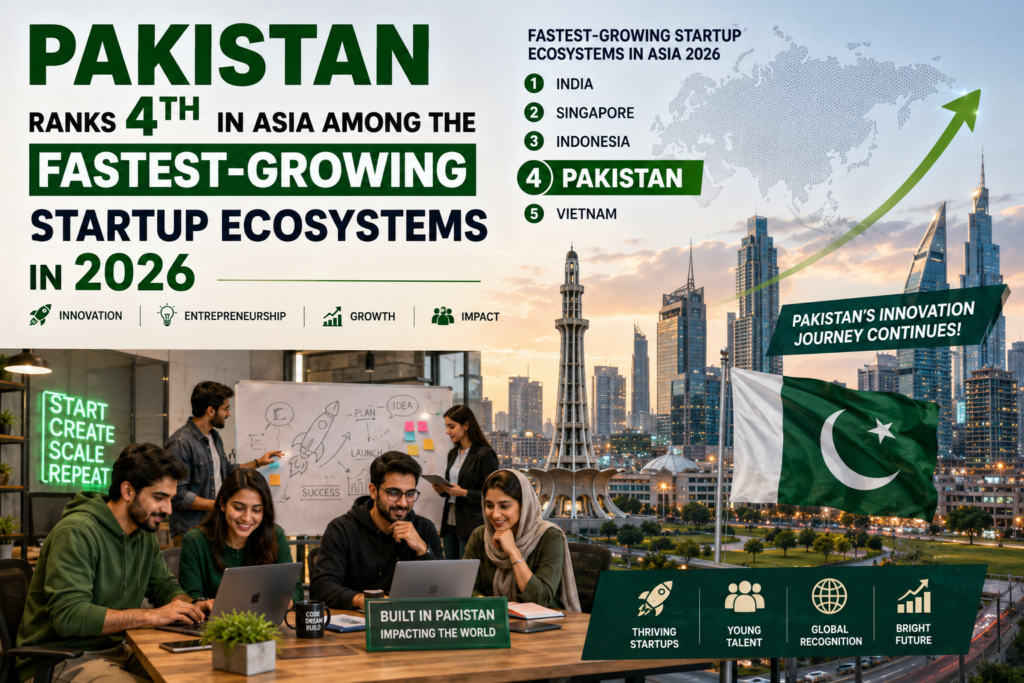
Pakistan’s rapid expansion has placed it 4th among Asia’s fastest-growing startup ecosystems, according to the ranking being highlighted in current coverage of the 2026 startup landscape.
This position is best understood as a growth or momentum ranking, rather than a ranking of the largest startup ecosystems in Asia. Countries such as India, Singapore and other established technology markets have considerably larger startup ecosystems in terms of capital, companies and global reach.
Pakistan’s significance lies in the speed at which its ecosystem is developing.
The distinction is important because a rapidly growing emerging ecosystem can have a lower overall ranking while still recording stronger annual growth than a much larger and more mature market.
Pakistan’s startup momentum is being supported by several developments taking place simultaneously. Digital payments are expanding, e-commerce is becoming more established, businesses are adopting technology and a growing number of young professionals are entering software development, freelancing and entrepreneurship.
The country’s technology workforce also gives startups access to talent capable of building products and services for both domestic and international customers.
This creates a valuable opportunity for Pakistani entrepreneurs: they can develop businesses locally while targeting customers beyond Pakistan’s borders.
Pakistan’s large young population is one of its strongest potential advantages in the digital economy.
Young Pakistanis are increasingly entering software development, artificial intelligence, digital marketing, design, e-commerce and online services. This creates a significant talent pool for startups and technology companies.
However, demographics alone cannot create a successful startup ecosystem. Education, skills, access to capital and opportunities to build businesses must work together.
If Pakistan can successfully connect its young talent with investment and global markets, the country’s startup sector could become an increasingly important part of the economy.
Financial technology has become one of the most visible areas of Pakistan’s startup ecosystem. Digital wallets, online payments and technology-driven financial services are helping expand access to digital transactions.
Companies such as SadaPay and NayaPay represent the growing interest in technology-enabled financial services in Pakistan.
The development of fintech also benefits other startups because digital payments make it easier for businesses to receive money, manage transactions and reach customers.
As digital financial infrastructure improves, it can create opportunities for entrepreneurs across sectors.
Pakistan’s e-commerce sector has also become an important part of the startup landscape.
Online marketplaces are changing how consumers discover and purchase products, while logistics companies are working to improve delivery, warehousing and transportation.
This creates an ecosystem effect. The growth of online commerce generates demand not only for retailers but also for payment providers, logistics companies, software developers, digital marketers and customer-service businesses.
As more consumers become comfortable with digital transactions, the potential size of Pakistan’s online economy continues to expand.
Pakistan’s large freelance workforce provides another foundation for entrepreneurship.
Developers, designers, writers, marketers and other digital professionals already work with international clients. Through this work, many gain experience in project management, international communication, product development and customer requirements.
For some, freelancing can become a stepping stone towards entrepreneurship.
Instead of selling individual services, experienced freelancers can eventually build products, agencies or technology companies capable of serving larger international markets.
This transition from freelancer to founder could become increasingly important for Pakistan’s digital economy.
Artificial intelligence is creating another opportunity for Pakistani entrepreneurs.
AI tools can help small teams perform tasks related to coding, research, marketing, customer support, data analysis and content production at a lower cost.
This can reduce some of the traditional barriers to launching a technology company.
For Pakistani startups, the opportunity is particularly significant because digital products can be developed locally and marketed globally.
But AI also creates intense competition. Pakistani companies will increasingly compete with startups from across the world, making product quality, innovation and execution more important than ever.
The rapid growth should not hide the challenges facing Pakistan’s startup ecosystem.
Pakistan ranks 67th globally in StartupBlink’s 2026 overall ecosystem ranking, which shows that its ecosystem is still significantly smaller and less mature than the world’s leading startup hubs.
Access to venture capital remains a major challenge. Startups need funding to build products, hire skilled employees and expand internationally.
Economic volatility, regulatory uncertainty, currency pressures and infrastructure limitations can also make long-term planning difficult for founders and investors.
The opportunity is therefore significant, but so is the work required to sustain it.
Startup ecosystems cannot grow sustainably without capital.
Early-stage funding allows founders to experiment, build products and hire teams. Later-stage investment allows successful companies to expand into new cities and international markets.
Pakistan has produced startups that have attracted international investment, but the depth of venture capital available to Pakistani companies remains below that of major Asian startup hubs.
A stronger connection between Pakistani founders and international investors could help the ecosystem move from rapid growth towards greater maturity.
This may ultimately be the most important question.
Pakistan has a large domestic market, but the biggest opportunity for many technology startups may lie outside the country.
Software, artificial intelligence, fintech infrastructure and digital services can be sold internationally without requiring a company to physically establish operations in every market.
If more Pakistani startups successfully enter international markets, they could generate foreign-exchange earnings while creating high-skilled employment inside Pakistan.
This could make startups an increasingly important component of Pakistan’s digital export strategy.
Universities have an important role in supporting this transformation.
Pakistan has thousands of students studying computer science, engineering, business and other disciplines relevant to entrepreneurship. Connecting these students with incubators, investors and established technology companies can help turn ideas into viable businesses.
University-based entrepreneurship programmes can also encourage students to view startups as a potential career path rather than simply seeking traditional employment.
The stronger the connection between education, research and industry, the more effectively Pakistan can develop its next generation of founders.
Pakistan’s startup activity is concentrated around major cities, particularly Karachi, Lahore and Islamabad.
These cities provide access to technology talent, universities, investors and business networks.
Karachi has developed strong activity in fintech, e-commerce and technology-enabled services, while Lahore has a growing technology and entrepreneurial community. Islamabad and Rawalpindi also benefit from a strong concentration of universities, technology professionals and digital businesses.
The continued development of multiple startup hubs can help create a more diversified national ecosystem.
The next stage of Pakistan’s startup development should focus on helping businesses move beyond the early stages.
Founders need easier access to funding, clearer regulations and stronger networks connecting them with investors and international customers.
The government, universities, investors and private sector all have a role to play.
If these stakeholders can create an environment where entrepreneurs can experiment, fail, learn and scale, Pakistan’s startup ecosystem could continue moving upward in global rankings.
Pakistan’s startup story is no longer simply about potential.
The country has demonstrated measurable ecosystem growth, with StartupBlink recording 62.2% annual growth in 2026. Its overall ranking of 67th globally and second in South Asia shows that there remains significant room for improvement, but the growth rate demonstrates that the ecosystem is moving rapidly.
The reported 4th-place position among Asia’s fastest-growing startup ecosystems adds another dimension to the story: Pakistan is not yet one of the continent’s largest startup markets, but its pace of development is attracting increasing attention.
The challenge now is to convert this momentum into sustainable companies, international investment and long-term economic value.
Pakistan’s startup ecosystem is entering a new phase.
With 62.2% annual ecosystem growth in 2026 and a reported 4th-place position among Asia’s fastest-growing startup ecosystems, the country is demonstrating that its entrepreneurial landscape is gaining momentum.
Pakistan still ranks 67th globally and second in South Asia in overall ecosystem strength, meaning there is substantial ground to cover before it can compete with Asia’s established startup hubs.
But the ingredients for further growth are increasingly visible: a young population, a growing technology workforce, expanding fintech and e-commerce sectors, a large freelance community and entrepreneurs increasingly looking towards global markets.
The real test will be whether Pakistan can turn this rapid growth into sustainable businesses that create jobs, attract investment and compete beyond its borders.
Pakistan’s startup ecosystem is growing fast. Now, the challenge is to make that growth last.
Pakistan recorded 62.2% annual growth in its startup ecosystem according to StartupBlink’s 2026 data.
Yes, Pakistan is being highlighted as 4th among Asia’s fastest-growing startup ecosystems. This refers to ecosystem growth rather than overall ecosystem size.
Pakistan ranks 67th globally in StartupBlink’s 2026 overall startup ecosystem ranking.
Pakistan ranks second in South Asia, behind India, in StartupBlink’s overall ecosystem ranking.
Technology adoption, fintech, e-commerce, digital services, freelancing, entrepreneurship and Pakistan’s growing technology workforce are among the major drivers.
Fintech, e-commerce, artificial intelligence, software, health technology, logistics and digital services are among the key areas attracting entrepreneurs.
Access to venture capital, economic uncertainty, regulatory challenges, infrastructure limitations and international market access remain important challenges.
Pakistan has significant potential, but sustained growth will depend on investment, policy stability, infrastructure, talent development and the ability of Pakistani startups to scale internationally.