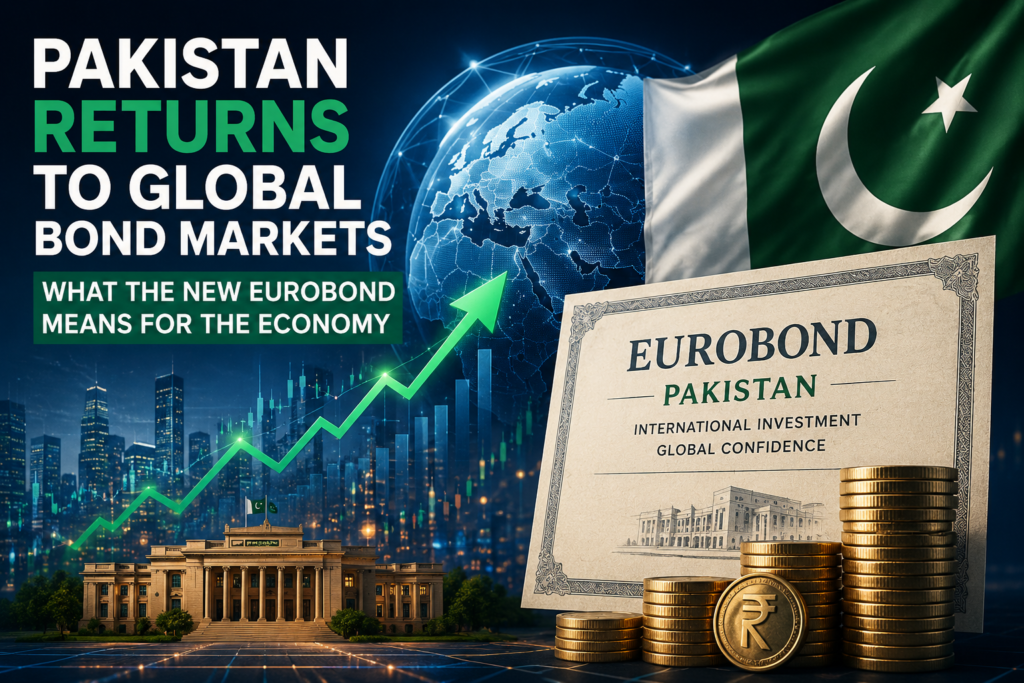
Pakistan is taking another step back into international financial markets as the government has launched the process for a new US-dollar-denominated dual-tranche Eurobond.

Pakistan is taking another step back into international financial markets as the government has launched the process for a new US-dollar-denominated dual-tranche Eurobond. The proposed transaction will include five-year and 10-year maturities, marking another important development in Pakistan’s efforts to regain regular access to global capital markets.
The move comes at a significant time for Pakistan’s economy. After years of external financing pressures, debt-servicing challenges and concerns over sovereign credit risk, the government is attempting to demonstrate that Pakistan can once again attract international investors.
The new Eurobond is therefore about more than raising foreign currency. It is also a test of how global investors view Pakistan’s economic trajectory, financial stability and ability to meet its future external obligations.
On September 1, 2026, Pakistan initiated the process for a benchmark US-dollar dual-tranche Eurobond. According to the Ministry of Finance and statements from Finance Minister’s Adviser Khurram Schehzad, the proposed transaction consists of five-year and 10-year tranches, with the final terms depending on market conditions and investor demand.

This means that Pakistan has entered the market to gauge investor interest and determine the terms under which the bonds could be issued. The final amount, pricing and allocation should therefore not be treated as finalized at this stage.
The government had previously indicated that it was looking to raise up to $2 billion through Eurobonds during the fiscal year, making the latest transaction part of a broader strategy to secure external financing and maintain access to international capital markets.
For years, Pakistan faced significant pressure on its external accounts, foreign-exchange reserves and ability to meet international debt obligations. Those pressures contributed to elevated borrowing costs and made international investors more cautious about Pakistani sovereign debt.
The latest Eurobond initiative reflects a different phase of Pakistan’s economic story. The government has highlighted successive sovereign credit-rating upgrades, improving macroeconomic fundamentals and stronger investor confidence as factors supporting the country’s renewed access to international capital markets.
Returning to the bond market can provide Pakistan with access to foreign currency financing while also offering an important signal to international investors. Successfully completing an international bond transaction can demonstrate that investors are willing to lend to Pakistan at market-determined rates.
However, access to international capital markets also comes with responsibilities. Dollar-denominated borrowing creates future repayment obligations in foreign currency, meaning Pakistan must continue strengthening its external earnings and reserves to manage those liabilities.
A Eurobond is a bond issued in a currency different from the currency of the country where the issuer is based. In Pakistan’s case, the current transaction is being structured in US dollars, allowing the government to borrow directly from international investors.
Investors purchase the bonds with the expectation of receiving interest payments and the repayment of principal when the bond matures. For the government, the advantage is access to a wider international investor base. The disadvantage is that the debt must ultimately be serviced in the foreign currency in which it was issued.
This makes Eurobonds an important tool for governments that need foreign currency financing, but they can also become expensive when a country’s credit risk rises or global interest rates increase.
The proposed structure includes two different maturities: five years and 10 years. Offering different maturities allows Pakistan to reach investors with different investment horizons and potentially build a broader demand base.
The five-year bond provides a relatively shorter repayment horizon, while the 10-year tranche represents longer-term borrowing. The pricing of both instruments will provide investors and analysts with a fresh indication of how international markets currently assess Pakistan’s sovereign risk.
If Pakistan secures favourable pricing, it could strengthen the perception that the country’s external financing position has improved. If borrowing costs remain high, however, it would indicate that investors continue to demand a significant premium for taking Pakistani sovereign risk.
The latest announcement follows Pakistan’s return to international capital markets earlier in 2026.
In April, Pakistan raised $500 million through a Eurobond, marking its return to the international bond market after a four-year gap. The bond reportedly carried an interest rate of around 6.95 percent and matured in April 2029.
The government subsequently completed another Eurobond transaction, with Pakistan increasing a three-year issuance to $750 million after strong investor demand and exercising a greenshoe option.
These transactions provide an important backdrop to the latest five-year and 10-year proposal. They suggest that Pakistan is attempting to move from an isolated return to international markets toward more regular access to global investors.
The immediate significance of the Eurobond is its potential to provide Pakistan with additional foreign-currency financing. This can help the government manage external financing requirements and support its broader balance-of-payments position.
However, borrowing itself does not solve an underlying economic problem. The funds eventually have to be repaid, along with interest. For that reason, the long-term benefit of the Eurobond depends on how effectively Pakistan manages its external finances and whether the economy generates sufficient foreign exchange through exports, remittances, investment and other sources.
A successful bond issuance can also improve market confidence. When international investors are willing to buy Pakistani debt, it can signal that they believe the country has a credible path toward meeting its financial obligations.
Perhaps the most important aspect of the latest Eurobond is not the money Pakistan may raise, but what investor participation says about international confidence.
The government has linked the new transaction to successive sovereign credit-rating upgrades and improving macroeconomic conditions. citeturn0search16 These developments can influence the interest rates investors demand when purchasing Pakistani debt.
A stronger credit profile generally makes it easier for a country to access international markets and can reduce borrowing costs over time. But investor confidence is not permanent. It depends on continued fiscal discipline, economic reforms, political stability, adequate foreign-exchange reserves and the country’s ability to meet external obligations.
For Pakistan, maintaining that confidence could prove just as important as completing the transaction itself.
While returning to international capital markets is a positive sign from an access perspective, Eurobonds remain a form of borrowing. Their cost matters greatly.
Pakistan must pay interest throughout the life of the bond and repay the principal when it matures. If international interest rates are high or investors perceive greater risk, the government may have to offer higher yields to attract buyers.
This is particularly relevant in the current global environment. International bond markets have recently faced renewed pressure from inflation concerns, higher oil prices and rising government borrowing costs. These global conditions can influence the price Pakistan must pay when seeking dollar financing.
The timing of Pakistan’s latest transaction therefore matters. The country is returning to international markets while global investors are becoming increasingly sensitive to interest rates, inflation and sovereign risk.
For ordinary Pakistanis, a Eurobond may appear to be a distant financial-market development. But government borrowing decisions can eventually affect the broader economy.
Foreign-currency debt creates future repayment obligations. The government must generate or obtain the dollars needed to service those obligations. If external financing is used alongside stronger exports, investment and economic growth, it can contribute to greater financial stability.
If borrowing simply postpones existing external pressures without addressing their underlying causes, however, future governments and taxpayers may face larger repayment obligations.
The real question is therefore not simply whether Pakistan can borrow internationally. It is whether the country can use external financing while simultaneously strengthening the economic foundations needed to repay it.
Pakistan’s return to international bond markets represents a shift from the emergency financing environment that dominated much of the country’s recent economic debate.
External financing from international institutions, bilateral partners and other sources remains important, but regular access to commercial capital markets provides another potential financing channel.
The challenge is maintaining that access. International investors will continue to evaluate Pakistan based on its fiscal position, foreign-exchange reserves, debt sustainability, economic reforms and political and policy stability.
A single successful transaction can open a door, but sustained credibility is what keeps that door open.
The proposed five-year and 10-year Eurobond will now move through the market process, with final pricing and terms depending on investor demand and prevailing market conditions.
For Pakistan, the transaction will offer an important test of international investor appetite. Strong demand and competitive pricing could reinforce the narrative of improving economic credibility. Weak demand or expensive borrowing costs, on the other hand, could indicate that international investors remain cautious.
Either way, the transaction will provide valuable information about how global markets currently assess Pakistan.
Pakistan’s latest Eurobond initiative represents more than another borrowing exercise. It is a test of the country’s renewed relationship with international financial markets.
The proposed five-year and 10-year dollar-denominated bonds come after Pakistan’s return to the Eurobond market earlier this year and amid government claims of improving macroeconomic fundamentals, stronger investor confidence and successive sovereign credit-rating upgrades.
The opportunity is significant, but so is the responsibility. Access to international capital can provide breathing room for an economy, but sustainable growth requires more than borrowing. Pakistan will ultimately need stronger exports, greater investment, disciplined fiscal management and continued economic reforms to ensure that today’s financing does not become tomorrow’s burden.
Pakistan is back in the global bond market. The real test now is turning renewed investor confidence into lasting economic stability.
Pakistan has launched the process for a US-dollar-denominated dual-tranche Eurobond consisting of proposed five-year and 10-year maturities. The final terms depend on market conditions and investor demand.
Pakistan has previously indicated that it is looking to raise up to $2 billion through Eurobonds during the fiscal year. However, the current transaction should not be described as a finalized $2 billion issuance until the final amount and terms are officially confirmed.
Eurobonds provide Pakistan with access to international investors and foreign-currency financing. They can help meet external financing requirements, but they also create future interest and principal repayment obligations.
Yes. Pakistan returned to the international bond market in April 2026 with a $500 million Eurobond after a four-year gap. Pakistan later increased another three-year Eurobond issuance to $750 million following strong investor demand.
The maturities indicate when the principal amount of each bond is scheduled to be repaid. The five-year tranche represents shorter-term borrowing, while the 10-year tranche provides longer-term financing.
Strong investor confidence can improve Pakistan’s ability to access international capital and potentially lower borrowing costs. Continued confidence, however, depends on economic reforms, fiscal management, external stability and Pakistan’s ability to meet its financial obligations.