Pakistani Hero is a private digital media platform dedicated to showcasing inspiring Pakistani professionals creators and achievers who are making a meaningful impact in their fields We document real journeys highlight genuine contributions and build long term digital recognition for individuals shaping Pakistan’s present and future nationally and globally. Pakistani Hero is a private digital media platform dedicated to showcasing inspiring Pakistani professionals creators and achievers who are making a meaningful impact in their fields We document real journeys highlight genuine contributions and build long term digital recognition for individuals shaping Pakistan’s present and future nationally and globally
Pakistan’s $6 Billion Refinery Upgrade 2026

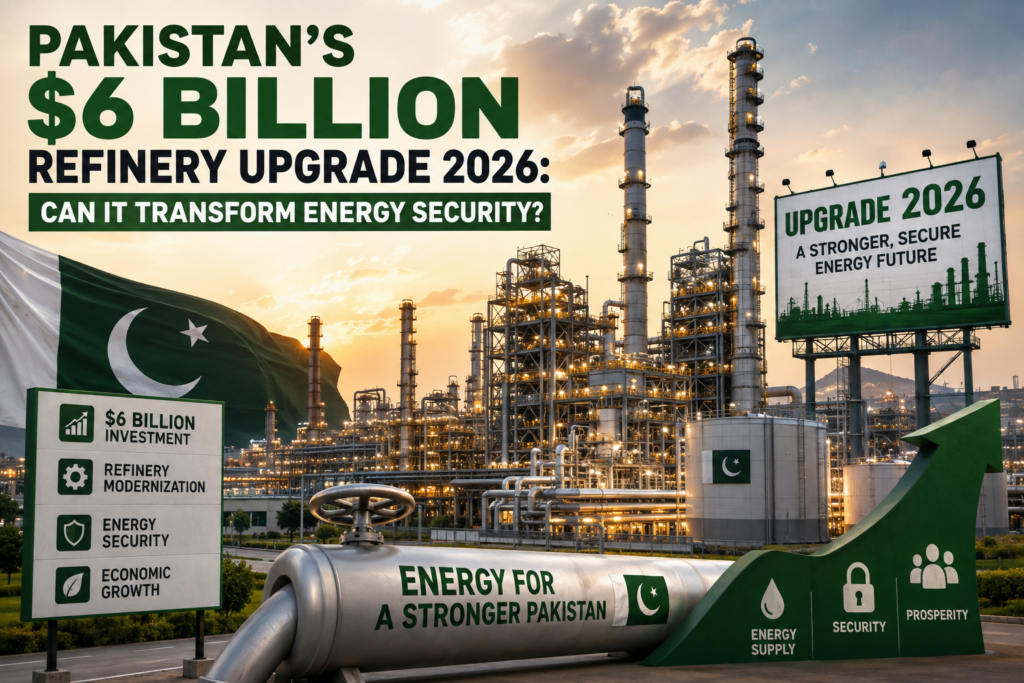
Pakistan’s $6 Billion Refinery Upgrade 2026: Can It Transform Energy Security?

Pakistan’s ageing oil-refining sector is finally moving towards one of its most significant modernisation efforts in years

Pakistan’s $6 Billion Refinery Upgrade: What It Means

Overview

Pakistan’s ageing oil-refining sector is finally moving towards one of its most significant modernisation efforts in years. Five major refineries, PARCO, Pakistan Refinery Limited, National Refinery Limited, Cnergyico and Attock Refinery Limited, are set to sign implementation agreements under the government’s Brownfield Refinery Upgradation Policy, with the programme expected to unlock more than $6 billion in investment. The latest reports indicate that the agreements are scheduled for signing on September 3, 2026, marking an important step after years of policy discussions and delays. 

The scale of the programme is significant for Pakistan’s energy sector. The country continues to depend heavily on imported petroleum products, while several domestic refineries operate with ageing infrastructure and production systems that are not fully aligned with current fuel demand. The planned upgrades aim to change that by increasing the production of petrol and high-speed diesel, improving fuel quality and reducing the country’s dependence on imported refined products.

But behind the headline figure is a bigger question: Can Pakistan finally turn refinery modernisation into stronger energy security and a more efficient domestic petroleum industry?

What Is Pakistan’s $6 Billion Refinery Upgrade Programme?

The much-discussed $6 billion-plus investment is not a single government payment or one standalone project. It represents the expected investment associated with modernising Pakistan’s five existing oil refineries under the revised Brownfield Refinery Upgradation Policy. The five companies involved are Pak-Arab Refinery Limited (PARCO), Pakistan Refinery Limited (PRL), National Refinery Limited (NRL), Cnergyico and Attock Refinery Limited (ARL).

What Is Pakistan’s $6 Billion Refinery

The programme is designed to upgrade existing facilities rather than build an entirely new refining system from scratch. If implemented successfully, the investment could improve refinery efficiency, change the mix of petroleum products being produced domestically and allow Pakistan to produce cleaner fuels that meet higher international standards.

The frequently quoted Rs 1.68 trillion figure is simply an approximate conversion of $6 billion into Pakistani rupees. For accuracy, the primary figure should therefore be described as more than $6 billion in planned investment, rather than as a completed Rs 1.68 trillion deal.

Why Does Pakistan Need to Upgrade Its Refineries?

Pakistan’s refining industry has been dealing with ageing infrastructure, limited conversion capacity and a product mix that does not always match domestic demand. While local refineries process crude oil into petroleum products, the country still needs to import significant quantities of refined fuel to meet consumption requirements.

Modernisation is intended to address this imbalance. The government expects upgraded refineries to produce more petrol and high-speed diesel while significantly reducing the production of lower-value furnace oil. The revised policy has been designed specifically to encourage existing refineries to make the large investments required for these changes. 

The objective is therefore not simply to make refineries newer. It is to make them more productive, commercially viable and better aligned with Pakistan’s actual energy needs.

Which Five Refineries Are Involved?

The programme covers all five major operating refineries that have been brought under the modernisation framework: PARCO, PRL, NRL, Cnergyico and ARL. Government officials have held meetings with the managements of all five companies to finalise implementation arrangements. 

Their participation makes the programme particularly significant because these refineries collectively represent a major part of Pakistan’s existing crude-processing capacity. Rather than waiting for completely new plants to become operational, the government is attempting to modernise infrastructure that already exists.

The next stage is therefore crucial. The signing of the agreements is an important milestone, but the real economic impact will depend on whether the projects move from agreements and feasibility studies to actual engineering, financing, construction and upgraded production.

What Will the Upgrades Change?

One of the most important objectives is to change the type and quality of fuel produced domestically. Reporting on the revised refinery policy indicates that the modernisation programme could increase petrol production by approximately 72 percent and high-speed diesel production by around 39 percent, while reducing furnace-oil production by approximately 63 percent. 

This would represent a major shift in Pakistan’s refining sector. Petrol and diesel are central to transportation and economic activity, while furnace oil has become a less attractive product as Pakistan’s energy system changes.

The upgrades are therefore intended to bring domestic refining closer to the needs of the Pakistani market while improving the overall efficiency of the industry.

Could This Reduce Pakistan’s Fuel Imports?

This is one of the biggest potential benefits of the programme. If domestic refineries are able to produce substantially more petrol and diesel, Pakistan could reduce the quantity of refined petroleum products it needs to purchase from international markets.

That would not make Pakistan completely independent from global energy markets. The country would still need crude oil and other energy supplies, and international oil prices would continue to influence the domestic economy. However, producing a larger share of refined fuel locally could reduce exposure to international refined-product markets and help conserve foreign exchange.

In simple terms, the objective is not to eliminate imports altogether. It is to process more of Pakistan’s required fuel domestically and reduce unnecessary dependence on imported finished products.

What Does Euro-5 Fuel Mean for Pakistan?

Another important element of the modernisation programme is fuel quality. Petroleum Minister Ali Pervaiz Malik has said that upgraded refineries will enable Pakistan to produce Euro-5 standard fuel products. 

Euro-5 standards place tighter limits on certain pollutants in fuel compared with older standards. For Pakistan, moving towards cleaner fuel production could support broader efforts to improve air quality and reduce vehicle-related emissions, although fuel quality alone cannot solve the country’s air-pollution problem.

The transition will ultimately depend on the technical upgrades carried out by individual refineries and the effective implementation of fuel-quality standards across the market.

Why Is Refinery Modernisation Important for Energy Security?

Pakistan’s dependence on international energy markets leaves the country vulnerable to global price fluctuations, shipping disruptions and geopolitical crises. Recent disruptions to regional energy routes have once again highlighted the importance of maintaining reliable domestic fuel supplies.

The government has therefore increasingly linked refinery modernisation with energy security. A stronger domestic refining system would give Pakistan greater flexibility in managing petroleum supplies and could reduce its dependence on imported refined products. 

However, energy security requires more than refineries. Storage facilities, pipelines, ports, transportation networks and reliable crude supplies are equally important. Refinery upgrades should therefore be viewed as one component of a broader energy-security strategy.

Will Petrol Prices Come Down?

For ordinary consumers, this is perhaps the most interesting question.

Higher domestic refining capacity could reduce some of the costs and risks associated with importing refined petroleum products. Increased local production could also improve supply security during periods of international disruption.

However, it would be misleading to promise that the refinery upgrades will automatically make petrol cheaper. Pakistan’s fuel prices are influenced by international crude prices, exchange rates, taxes, petroleum levies, transportation costs and other factors.

The more immediate potential benefit is therefore greater domestic supply and reduced import dependence, rather than a guaranteed reduction in petrol prices.

What Is the Brownfield Refinery Upgradation Policy?

The Brownfield Refinery Upgradation Policy focuses on improving existing refineries rather than developing completely new plants. The revised framework provides incentives and policy support intended to encourage refinery companies to invest billions of dollars in modernisation.

The policy has taken years to develop because refinery companies and the government have had to address questions surrounding taxation, incentives, investment returns and implementation arrangements. The latest version was approved in July 2026 after prolonged discussions, paving the way for the agreements now being finalised. 

The significance of the current moment is that the policy is moving from a regulatory document towards actual investment agreements.

Why Are the Agreements Being Signed Now?

The government has been working with the refineries for months to resolve implementation issues and establish the framework under which the upgrades will take place. On August 28, the Petroleum Division announced that all five refineries had reaffirmed their readiness to sign agreements and that the programme could attract more than $6 billion in investment. 

By September 2, reports indicated that the agreements were being finalised for signing on September 3, with the government authorising Inter State Gas Systems (ISGS) to sign and oversee their implementation. 

That makes September 3 an important date for Pakistan’s downstream petroleum sector. But it is also important to remember that signing an agreement is the beginning of the investment process, not its completion.

How Long Will Modernization Take?

The upgrades are expected to be long-term projects rather than changes that will happen overnight. Each refinery will need to conduct feasibility studies, technical assessments, engineering work and financing arrangements before major construction and equipment installation can take place.

Industry sources cited in recent reporting have described the process as potentially taking several years, with one source describing the overall development period as potentially around seven years. 

This means Pakistan should not expect the full benefits of the $6 billion programme immediately after the agreements are signed. The impact will emerge gradually as individual refinery projects reach different stages of completion.

Could the Programme Create Jobs?

Large-scale refinery modernisation could generate employment during engineering, construction and installation phases. It could also create demand for technical specialists, engineers, contractors, equipment suppliers and other industrial services.

The longer-term benefit could be even broader if a more modern refining sector encourages investment across related industries such as logistics, petroleum storage, transportation and industrial manufacturing.

However, the exact number of jobs cannot yet be reliably stated because each refinery will have its own investment plan and implementation schedule.

The Importance of Local Industrial Capacity

The refinery programme also matters from a broader industrial perspective. Pakistan has historically struggled to attract large-scale investment into energy infrastructure because of policy uncertainty, financing constraints and concerns about commercial returns.

If the current programme is implemented successfully, it could demonstrate that major industrial projects can move from policy negotiations to long-term investment.

That could help strengthen investor confidence in Pakistan’s wider energy and industrial sectors.

Pakistan Is Also Exploring a New Greenfield Refinery

The brownfield programme is not Pakistan’s only refinery initiative. The government has also announced progress on a proposed $4.5 billion deep-conversion greenfield refinery project at Hub, Balochistan, which is separate from the upgrades planned for the five existing refineries. The government has described the proposed project as an opportunity to strengthen energy security and industrial development.

The distinction between the two programmes is important. Brownfield projects modernise existing facilities, while the Hub project represents a proposed new refining facility.

Together, they indicate that Pakistan is exploring both approaches to strengthening its refining capacity.

What Could This Mean for Pakistan’s Economy?

The potential economic impact extends beyond fuel production. A more efficient refining sector could reduce some reliance on imported refined petroleum products, potentially helping the country manage its foreign-exchange requirements.

The investment itself could also generate activity across engineering, construction, logistics, equipment supply and other industrial services.

Over the longer term, a modern refining sector could make Pakistan’s downstream petroleum industry more competitive and better prepared to respond to changing domestic fuel demand.

But these benefits depend on execution. The headline investment figure will matter far less than how much capital is actually deployed and what production improvements are achieved.

What Are the Biggest Challenges?

The biggest challenge is implementation. Pakistan has discussed refinery modernisation for years, and previous attempts were delayed by disagreements over policy incentives, taxation and investment conditions.

The latest agreements are intended to provide greater clarity, but financing and technical feasibility will still determine how quickly individual projects progress. Recent reporting has also stressed that the signing is only the first step in what could be a multi-year development process. 

Pakistan will also need to maintain a stable regulatory environment throughout the life of these projects. Large-scale refinery investments require confidence that policies will remain predictable long enough for companies to recover billions of dollars in capital expenditure.

The Bigger Picture

Pakistan’s refinery story is ultimately about much more than petrol and diesel.

For years, the country has imported large quantities of petroleum products while its domestic refining infrastructure struggled with ageing equipment and an outdated product mix. The planned modernisation programme offers an opportunity to change that equation.

The expected $6 billion-plus investment across five refineries could increase domestic production of higher-value fuels, improve fuel quality and reduce dependence on imported refined petroleum products. The government has also linked the upgrades directly to Pakistan’s broader energy-security objectives. 

But the real test begins after the agreements are signed. Pakistan now has to convert policy into investment, investment into infrastructure and infrastructure into actual economic benefits.

What Happens Next?

The immediate milestone is the signing of the implementation agreements between the government and the five refineries. According to the latest reports available before September 3, the agreements are scheduled to be signed today, with ISGS responsible for signing and overseeing implementation on behalf of the Petroleum Division. 

After that, each refinery will move through its own feasibility, engineering, financing and development process. The success of the programme will ultimately be judged by whether the planned upgrades are completed and whether they deliver the promised increases in petrol and diesel production.

For Pakistan, the next few years could determine whether refinery modernisation becomes a genuine energy-sector transformation or another long-delayed industrial reform.

Conclusion

Pakistan’s planned $6 billion-plus refinery modernisation programme represents one of the most ambitious efforts to reshape the country’s downstream petroleum sector in years. Five major refineries, PARCO, PRL, NRL, Cnergyico and ARL,  are moving towards implementation agreements under the revised Brownfield Refinery Upgradation Policy. citeturn0search20turn0search21

The potential benefits are significant. Higher petrol and diesel production, Euro-5 fuel capability, lower furnace-oil output and reduced reliance on imported refined petroleum products could strengthen Pakistan’s energy security and improve the efficiency of its domestic refining industry.

But the real challenge starts after the signing. The investment needs to be financed, projects need to be executed and upgraded refineries need to deliver the production improvements promised under the policy.

For Pakistan, this is not simply about upgrading five oil plants.

It is about whether the country can turn a long-awaited refinery reform into lasting energy security. 

FAQS

It is a planned modernisation programme involving Pakistan’s five major oil refineries. The government expects the agreements to unlock more than $6 billion in investment to upgrade existing facilities, increase domestic fuel production and improve fuel quality. 

The five refineries are Pak-Arab Refinery Limited (PARCO), Pakistan Refinery Limited (PRL), National Refinery Limited (NRL), Cynergico and Attock Refinery Limited (ARL). 

The more accurate figure is more than $6 billion in planned investment. Rs 1.68 trillion is an approximate conversion of $6 billion into Pakistani rupees and should not be described as a single completed government investment.

They are expected to reduce Pakistan’s dependence on imported petrol and diesel by increasing domestic production. However, Pakistan will continue to rely on international markets for crude oil and other energy supplies. 

It could improve domestic supply and potentially reduce some import-related costs, but it does not guarantee cheaper petrol. Domestic fuel prices will continue to depend on global oil prices, exchange rates, taxes, petroleum levies and other factors.

It is a government policy designed to encourage investment in existing Pakistani refineries so they can modernise their plants, improve efficiency, increase production of higher-value fuels and produce cleaner fuel products. 

The revised policy is reported to target an approximately 72 percent increase in petrol production and a 39 percent increase in high-speed diesel production, while reducing furnace-oil production by around 63 percent.

The benefits will take several years to materialise. The signing of agreements is only the beginning, followed by feasibility studies, engineering, financing, construction and commissioning. Industry sources have indicated that the overall process could take several years. 

About This Story

BE PART OF OUR MISSION

Share Real Stories of Pakistan

Do you know someone who is making Pakistan proud? Nominate them and we will tell their story.

Latest News

Book a meeting