An idea that previously seemed marginal has now become a central topic in Pakistan’s political discussions in 2026: should the federal capital, Islamabad, be turned into the nation’s next province? This question has picked up significant steam lately, fueled by top federal officials, an official governance plan handed to the prime minister, and a broader nationwide conversation about reshaping Pakistan’s administrative boundaries.
The issue of Islamabad is inherently tied to that wider discussion. Pakistan presently consists of four provinces, two autonomous territories, and one federal capital territory, and for many years, political parties and regional factions have intermittently demanded the creation of more provinces. What sets this moment apart is the degree of governmental support the proposal has gained, along with the strong opposition it has provoked from at least one current province. This has led to a real constitutional and political conflict over how Pakistan ought to be administered, and who holds the authority to make that decision.
The core of the ongoing debate is a formal governance framework, not merely political talk. A high-level special committee has presented a proposed governance framework to the prime minister, suggesting the creation of an Islamabad Assembly and granting the capital increased administrative and financial independence. According to the draft, the assembly would consist of 27 members, with 21 directly elected, and each of the capital's National Assembly constituencies would be assigned seven seats, five reserved for women, and one for minorities.

The framework goes beyond simply adding a legislature. The draft suggests placing Islamabad under an empowered local government, providing residents with their own elected assembly and chief executive, and consolidating administrative powers in the capital under a unified local government structure. In essence, the proposal is being presented not as a symbolic change but as a practical reorganization of the capital’s daily administration.
The current effort can be traced back to the interior minister. The latest round of discussion started on July 30, when Interior Minister Mohsin Naqvi argued that Pakistan’s existing governance structure was no longer effective, saying during a televised address that the system had “collapsed” and had been maintained for over 70 years, and suggesting new administrative divisions as a solution. The next day, the ISPR director general also urged a serious discussion on the proposal, lending the idea further institutional support.
Several weeks later, the planning minister greatly expanded the scope. Planning and Development Minister Ahsan Iqbal suggested creating 12 to 15 new provinces in total, describing Pakistan’s four existing provinces as increasingly centralized and asking the prime minister to establish a committee to launch a national and political debate on what is feasible. He was cautious to acknowledge the boundaries of his own authority on this matter, emphasizing that achieving political consensus would be crucial before any such change could be implemented.
Backers of the idea largely present it in terms of representation and resources. Naqvi has said that if new provinces are to be established, Islamabad ought to be part of them, noting that public sentiment matters more on this matter than the opinions of politicians. He has also raised a concrete complaint: he advocated for a discussion on provincial status for Islamabad because residents of the federal capital do not get a portion under the National Finance Commission (NFC) Award.
That point about resources has resonated among ordinary people. The Noor PurShahaan Community Development Organisation has endorsed the plan to turn Islamabad into a separate province, suggesting it might help resolve long-standing civic, political, and constitutional issues facing the capital’s residents. The group’s leaders observed that major political parties had not seriously pursued an Islamabad province or a share of the NFC Award to fund the capital’s development, and they highlighted that young people with Islamabad domicile, unlike those from other provinces, currently have no dedicated job quota, even though applicants from every federating unit can apply for positions in the capital.
At the same time, Naqvi has attempted to manage expectations. During a National Policy Dialogue in Lahore, he asked political parties and citizens not to “get emotional about the issue,” emphasizing that this would not happen quickly, while also questioning whether existing provinces have cities with the administrative and economic significance of Lahore, Karachi, Peshawar, and Quetta like Islamabad does. He has also stated that new administrative units should not be formed along ethnic lines, and that a “reset” of the system does not mean tearing it down, but fixing what has gone wrong.
Backing for the idea has not been unanimous, even among those within the broader circle of the governing coalition. Abdul Aleem Khan, leader of the Istehkam-i-Pakistan Party, welcomed Ahsan Iqbal’s remarks about establishing new provinces, noting that it was encouraging to see national leaders adopting a constructive stance on the proposal.
In contrast, opposition parties have raised pointed concerns regarding the government’s own internal coordination. The PTI has challenged Prime Minister Shehbaz Sharif’s silence on an issue it views as having significant constitutional and political implications, questioning why the prime minister has stayed largely out of the discussion while the interior minister has effectively shaped the federal government’s position on the matter for months.
On an official level, the government maintains that no decision has been made. A senior official, speaking anonymously to The News, stated that the current debate about new provinces and administrative units is not directed at any specific province or region, and that its main purpose is to enhance governance and make the state’s administrative system more responsive to citizens, adding that there is still no final determination on whether Pakistan requires more provinces, additional administrative units, or simply increased devolution to district and local-government levels.
The most forceful pushback against the broader provinces debate has emerged from Sindh, and that carries direct consequences for how any Islamabad proposal might be received in other regions. The Sindh Assembly passed a unanimous resolution rejecting any move to split the province or change its borders, while opposition lawmakers walked out in protest; the resolution, introduced by PPP leader Nisar Ahmed Khuhro, pointed out that the assembly had adopted similar resolutions in 1948, 2012, 2013, 2014, 2019, and earlier in 2026. It referenced Article 239(4) of the Constitution, which mandates a two-thirds majority vote in a provincial assembly before any constitutional amendment altering that province’s boundaries can be submitted to the president for approval, and it dismissed any plan to separate a district, division, region, or territory from Sindh or to place any portion of it under a separate or federal administrative system.
Sindh’s chief minister has been just as straightforward. Chief Minister Murad Ali Shah has firmly rejected calls to split Sindh, asserting that only elected representatives in the provincial assembly can decide the province’s future—not businessmen, political rallies, or television shows—and noting that the province had passed anti-division resolutions in 1948, 2000, 2014, 2019, and again in 2026.
The PPP has sharpened its rhetoric even further. The party strongly criticized recent remarks by federal ministers about new provinces and administrative units, warning that such comments amounted to interference in Sindh’s constitutional position, and cautioned that if federal ministers persisted, the PPP would view the federal government itself as behind what it termed a conspiracy against the province. Civil society has voiced the same concern on the streets: a “Sindh Unity March” in Karachi, organized by the Sindh United Party and the Sindh United Lawyers Forum, brought together lawyers, students, intellectuals, and activists opposing calls for new provinces or administrative units.
Sindh’s objections highlight a larger reality: forming a new province, or upgrading Islamabad’s position, is not merely an administrative matter. It demands a constitutional amendment, and any modification impacting an existing province’s borders must be approved by that province’s legislature with a two-thirds majority. Since Islamabad Capital Territory is federal, not provincial, territory, altering its status would take a different constitutional route than carving land from Sindh, Punjab, Khyber Pakhtunkhwa or Balochistan yet it would still require parliamentary agreement that, as of now, is not clearly present.
This is one reason officials still describe the process as being in its early phases, with the result uncertain even as proposals are formally recorded and submitted.
For residents of the capital, this debate is not just an abstract one. Those advocating for provincial status highlight concrete, daily issues: the capital receives no share from the NFC Award, there is no dedicated job quota for youth registered in Islamabad as other provinces have, and the governance setup is currently under federal control rather than a locally elected administration. An elected Islamabad Assembly, together with a directly chosen chief executive, would mark a major departure from the present system, moving closer to real local self-rule.
At the same time, any such change brings uncertainty for residents in the short term, including concerns about how a new assembly would work with existing local institutions and how soon, if ever, such a plan could go from proposal to reality.
For residents of the capital, this debate is not just an abstract one. Those advocating for provincial status highlight concrete, daily issues: the capital receives no share from the NFC Award, there is no dedicated job quota for youth registered in Islamabad as other provinces have, and the governance setup is currently under federal control rather than a locally elected administration. An elected Islamabad Assembly, together with a directly chosen chief executive, would mark a major departure from the present system, moving closer to real local self-rule.
At the same time, any such change brings uncertainty for residents in the short term, including concerns about how a new assembly would work with existing local institutions and how soon, if ever, such a plan could go from proposal to reality.
As of early September 2026, the situation remains uncertain. A formal governance framework for Islamabad has been presented to the prime minister, key federal ministers have publicly endorsed the proposal, and grassroots organizations in the capital have welcomed it. Concurrently, the government has refrained from confirming any final decision, opposition parties are urging the prime minister to clarify his position, and Sindh has made it abundantly clear that any proposal affecting its own borders will be opposed through every constitutional and political means available.
Whether Islamabad becomes Pakistan’s next province, obtains a more limited form of local self-governance, or the proposal fails entirely, the coming months are likely to determine how and whether the federal capital’s political future changes.
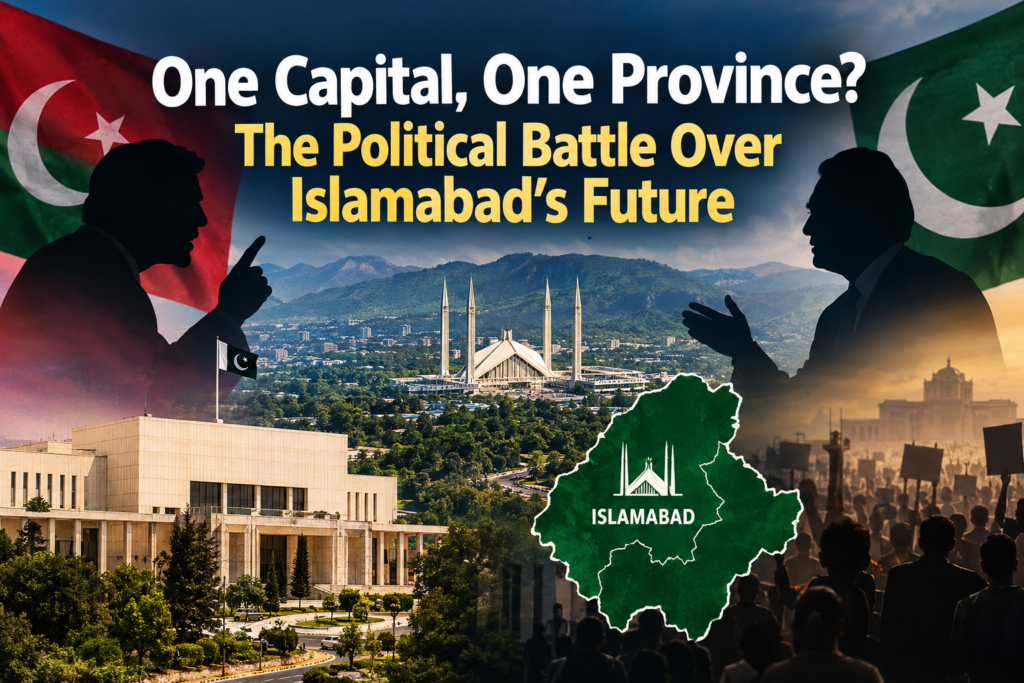
The headline’s question one capital, one province? remains unanswered for now. As of yet, there is no answer to that query. Currently, what exists is a detailed governance structure, strong backing from ministers, growing interest from civil society in the capital, and a nationwide discussion about provincial restructuring that has already met with significant opposition elsewhere in the country. Residents of Islamabad have concrete and specific complaints fueling the demand for changefrom the NFC Award to job quotasbut converting these complaints into a new provincial assembly would require a political consensus that, as the government itself admits, is not yet present. For the time being, the dispute over Islamabad’s future is still being resolved in committee rooms, press conferences, and assembly halls rather than being concluded.
A governance framework submitted to the prime minister recommends a 27-member Islamabad Assembly (21 directly elected, five reserved for women, one for minorities), along with an empowered local government and a directly elected chief executive for the capital.
Interior Minister Mohsin Naqvi has been the most vocal proponent, alongside grassroots groups like the Noor PurShahaan Community Development Organisation. Planning Minister Ahsan Iqbal has separately proposed a much broader restructuring involving up to 12-15 new provinces nationally.
? Two main arguments are cited: Islamabad currently receives no share of the National Finance Commission (NFC) Award, and Islamabad-domiciled youth have no dedicated employment quota, unlike applicants from Pakistan's existing provinces.
No. Officials have said the debate remains at an early stage, with no final decision yet on whether Pakistan needs new provinces, new administrative units, or simply greater devolution to local governments.
The Sindh Assembly has repeatedly passed resolutions (most recently in 2026, and before that in 1948, 2012, 2013, 2014 and 2019) rejecting any division of the province, citing constitutional protections under Article 239(4) that require a two-thirds provincial assembly vote before territorial boundaries can be altered.
Not quite. Islamabad is federal territory, not part of an existing province, so a change to its status would not require another province's assembly to approve a loss of territory in the way a proposal to divide Sindh would.
Residents would gain a directly elected assembly and chief executive for the first time, shifting the capital from federal administration toward local self-governance, along with a stronger claim to NFC Award funding and employment quotas.