





Join Us
Follow us on social media for daily updates and inspiring stories

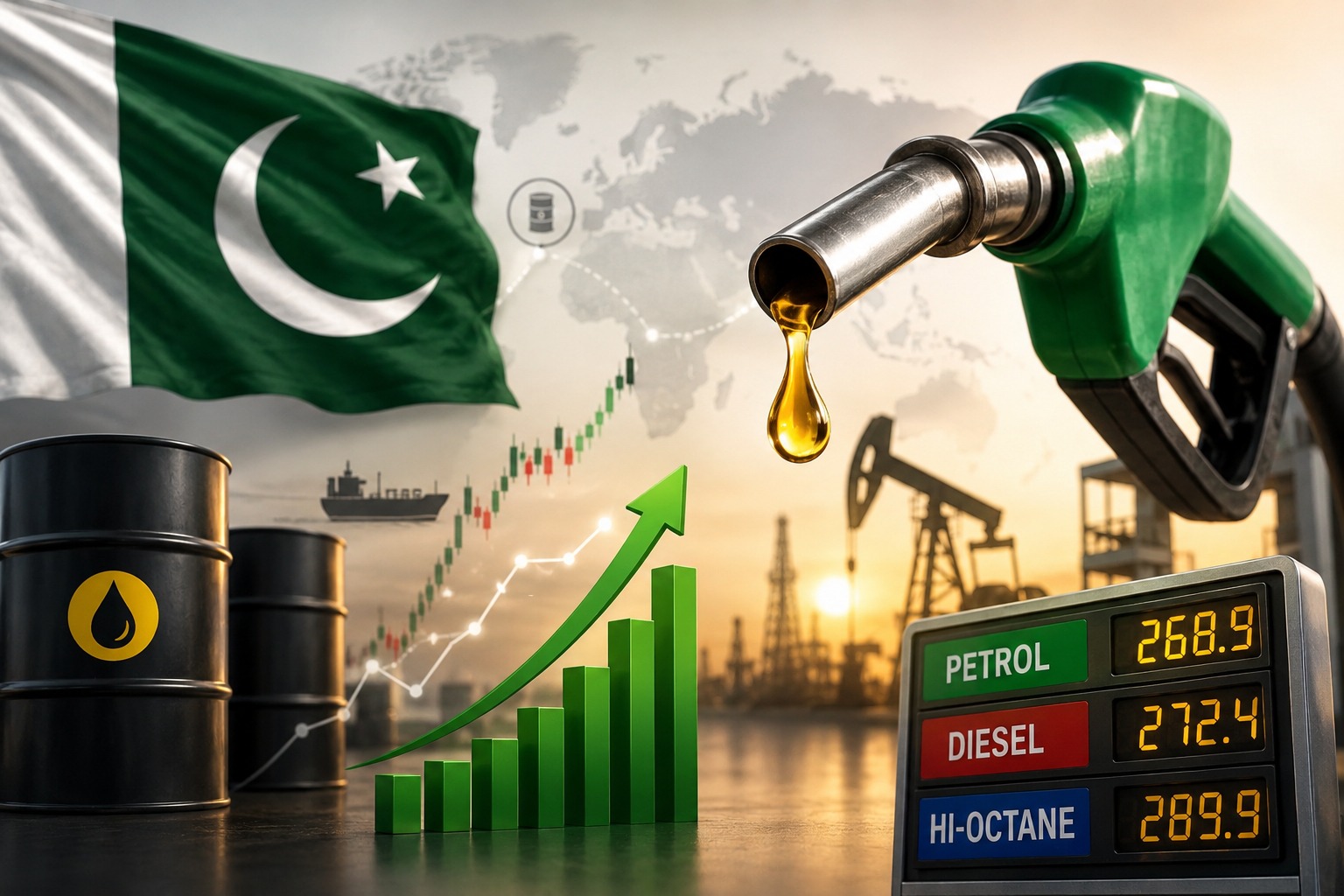
Whenever petrol prices change in Pakistan, the announcement immediately affects millions of motorists, businesses and households. But the price displayed at a fuel station is not determined by the global crude-oil price alone. It is the result of a pricing chain that connects international petroleum markets with Pakistan’s exchange rate, import costs, transportation expenses, regulated margins and government levies.
Understanding Pakistan petrol prices therefore requires looking at what happens before fuel reaches the pump.
Pakistan’s petroleum pricing framework uses international benchmark prices and converts them into rupees, while additional components such as inland freight, oil marketing company margins, dealer commissions and the petroleum levy are incorporated into the final price. OGRA publishes detailed price-build-up calculations and notifications for petroleum products.
In 2026, this mechanism became even more important as international oil markets experienced significant volatility, prompting the government to introduce temporary measures to cushion consumers from sharp increases.
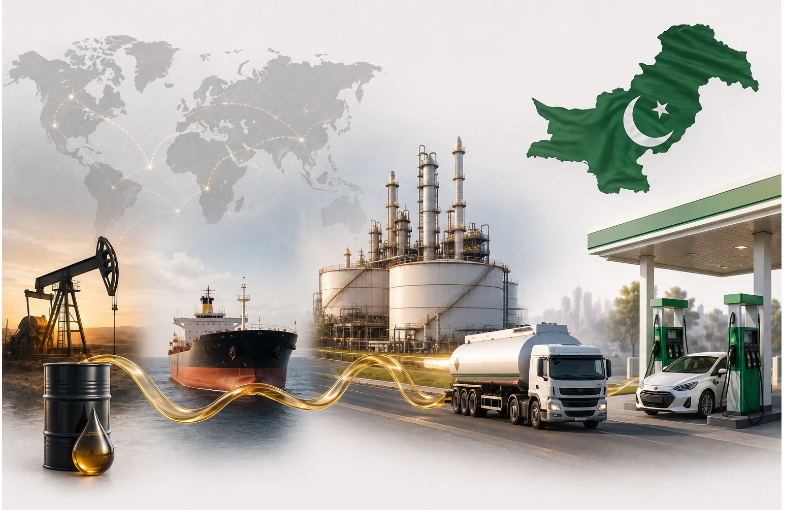
The first link in Pakistan’s fuel-price chain is the international petroleum market.
Petroleum products are traded internationally, and Pakistan’s domestic fuel costs are therefore influenced by global benchmark prices. OGRA’s pricing documents show that the calculation for petroleum products uses Arab Gulf benchmark prices, together with other import-related components and the exchange rate.
This means events outside Pakistan can affect what consumers eventually pay locally.
Geopolitical tensions, supply disruptions, shipping risks and changes in global demand can all influence international petroleum prices. During periods of market volatility, the government closely monitors benchmark prices, cargo premiums, shipping arrangements, insurance and petroleum stocks.
For example, Pakistan’s Finance Division reported in July 2026 that international oil markets remained highly volatile, with increases in benchmark prices and cargo premiums affecting petrol and diesel procurement costs.
The price at a Pakistani fuel station is therefore partly a reflection of developments taking place in international energy markets.
Step 1: The International Benchmark Price
The process begins with the international benchmark used to determine the underlying petroleum cost.
For petrol, this is not simply the price of crude oil. The relevant petroleum-product benchmark is incorporated into the ex-refinery or import-parity calculation.
OGRA’s February 2026 calculation, for example, lists Arab Gulf FOB mean prices for gasoline alongside the exchange rate as inputs into its ex-refinery sale-price calculation.
This distinction is important.
Crude oil must first be refined into products such as petrol and diesel. Therefore, the international price of the refined product can differ from the headline price of crude oil reported in global news.
As international product prices rise, Pakistan’s underlying import or ex-refinery cost can rise as well.
Step 2: The Dollar-Rupee Exchange Rate
The second major factor is the exchange rate.
International petroleum is priced in US dollars, while consumers in Pakistan pay in Pakistani rupees. The international cost therefore has to be converted into local currency.
OGRA’s official pricing calculations explicitly include an exchange-rate component.
This creates two separate channels through which global energy prices can affect Pakistan.
If international petroleum prices increase, the import cost rises.
If the Pakistani rupee weakens against the US dollar, the same dollar-denominated petroleum cost becomes more expensive in rupee terms.
As a result, even when international petroleum prices remain relatively stable, movements in the exchange rate can influence the domestic price calculation.
This is one reason Pakistan’s petrol prices cannot be understood by looking at crude oil prices alone.
Step 3: Inland Freight Equalization Margin
After petroleum is imported or refined, it has to move through Pakistan’s distribution network.
Transportation from refineries, ports and storage facilities to different parts of the country creates additional costs. The Inland Freight Equalization Margin (IFEM) is an important component of Pakistan’s petroleum-pricing system.
According to OGRA, the IFEM mechanism is designed to equalize fuel prices across designated depots despite differences in transportation costs. Its calculation incorporates transportation-related costs and other approved components.
OGRA’s petroleum notifications show IFEM as a distinct component of the ex-depot price calculation.
This means the price paid by consumers is not simply the international value of the fuel converted into rupees. The domestic logistics required to move petroleum around Pakistan also form part of the pricing chain.
Step 4: Oil Marketing Company and Dealer Margins
Petroleum must pass through a commercial distribution network before reaching consumers.
Oil marketing companies handle activities such as procurement, storage and distribution, while fuel dealers operate retail outlets where consumers purchase petrol.
The pricing framework therefore includes regulated margins for these participants.
OGRA’s official price notifications separately identify the oil marketing company/distributor margin and dealer commission as components of the maximum ex-depot sale price.
These margins are different from the international cost of petroleum itself. They represent regulated components associated with the domestic petroleum supply and retail chain.
Understanding this distinction helps explain why the price consumers see at the pump is higher than the underlying international petroleum benchmark.
Step 5: Petroleum Development Levy
One of the most significant government components in the fuel-price structure is the Petroleum Development Levy (PDL).
The levy is imposed by the federal government and forms part of the price paid by consumers.
OGRA’s official calculations show the petroleum levy as a separate component alongside the ex-refinery/import-parity price, IFEM, OMC margin and dealer commission.
The levy is also an important source of federal revenue.
Pakistan’s FY2026–27 Federal Budget estimates petroleum-levy revenue at approximately Rs1.677 trillion.
This creates an important policy trade-off. A higher levy can generate additional government revenue, while reducing the levy can lower the burden on consumers when fuel prices are under pressure.
Step 6: Sales Tax and Other Applicable Components
Taxes and other applicable government charges can also affect the final price.
OGRA’s price-build-up documents separately identify sales tax, where applicable, alongside the other components of the petroleum price.
The exact tax treatment and rates can change through government policy and legislation. Therefore, historical examples should not automatically be treated as the current pricing formula.
This is particularly important when comparing petrol prices across different years.
A price calculation from 2024 or 2025 may contain different levy, tax or margin rates from those applicable in 2026.
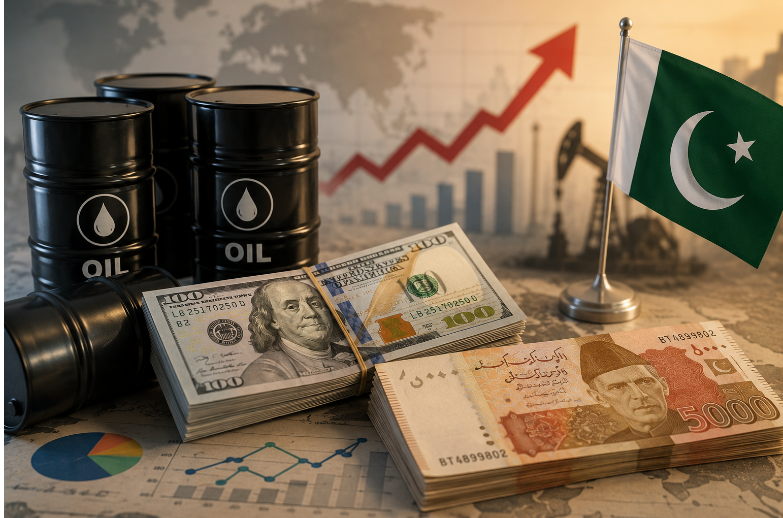
The entire process can be simplified as:
International petroleum benchmark
This is a simplified representation rather than a substitute for OGRA’s detailed calculation.
Space research also contributes to education, scientific innovation, and technological capacity building by encouraging research in engineering, robotics, artificial intelligence, and aerospace sciences.
As Pakistan modernizes its digital economy, space technology will become increasingly important for national infrastructure and innovation.
The frequency of price adjustments has also evolved.
Pakistan moved to weekly adjustments of gasoline and diesel prices in March 2026, according to the IMF’s April 2026 country report on Pakistan. The report explains that the change came during a period of exceptional international oil-price volatility.
The IMF also notes Pakistan’s broader commitment to aligning domestic fuel prices with international markets through regular adjustment mechanisms.
For readers, the important point is that fuel prices can respond more quickly to international market conditions than they did under a less frequent adjustment cycle.
Because the adjustment mechanism can evolve through policy decisions, consumers should rely on the latest official OGRA and government notification rather than assuming a fixed adjustment schedule indefinitely.
The importance of this pricing mechanism became particularly visible in 2026 when international oil markets experienced severe volatility.
Pakistan’s government monitored global oil prices, petroleum stocks, imports, freight, insurance and supply routes as international market conditions deteriorated.
Rather than passing the entire increase immediately to consumers, the government temporarily shielded consumers from part of the international price shock.
On March 25, 2026, the Finance Division announced that OGRA had received an initial Rs27 billion from the Prime Minister’s Austerity Fund to settle price-differential claims arising from the government’s decision to protect consumers from rising international oil prices.
The episode demonstrated an important feature of fuel pricing in Pakistan: the government can temporarily intervene to reduce the immediate impact on consumers, but doing so creates a fiscal cost.
Pakistan’s future petrol-price trajectory will continue to depend heavily on international energy markets and the country’s foreign-exchange position.
Global geopolitical developments can affect oil supply, shipping routes and product premiums. Domestic economic conditions can influence the rupee value of imports. Government decisions on petroleum levies, taxes and consumer relief can further change the final price.
At the same time, investments in refinery modernization could gradually strengthen domestic energy security.
The long-term challenge is to create a fuel-pricing system that reflects international costs while protecting vulnerable households from sudden shocks without placing unsustainable pressure on public finances.
For consumers, the most useful approach is to follow official OGRA notifications and Finance Division announcements rather than relying on social-media claims or outdated price formulas.
The price of petrol in Pakistan is the final result of a complex journey.
It begins with international petroleum benchmarks and is converted into rupees using the relevant exchange rate. Import and inland freight costs, oil marketing and dealer margins, the petroleum levy and applicable taxes are then incorporated into the pricing structure.
The events of 2026 demonstrated how quickly international oil-market volatility can become a domestic economic issue. They also showed the government’s ability to temporarily shield consumers, although such intervention comes with a fiscal cost.
Looking ahead, refinery modernization, stronger energy security and transparent pricing mechanisms will remain important. For ordinary consumers, understanding how the system works makes one thing clear:
The price on the fuel pump is not just the price of oil, it is the combined cost of the global market, Pakistan’s economy, its supply chain and government policy.